How Does Traditional Feng Shui Assess a Site and Its Surroundings?
September 29, 2026Uncategorized
Beyond Admiring the Landscape
An old saying from the Analects observes that “the wise delight in water, while the humane delight in mountains.” Its philosophical meaning belongs to another discussion, but the image of mountains and water offers an appropriate place to begin.
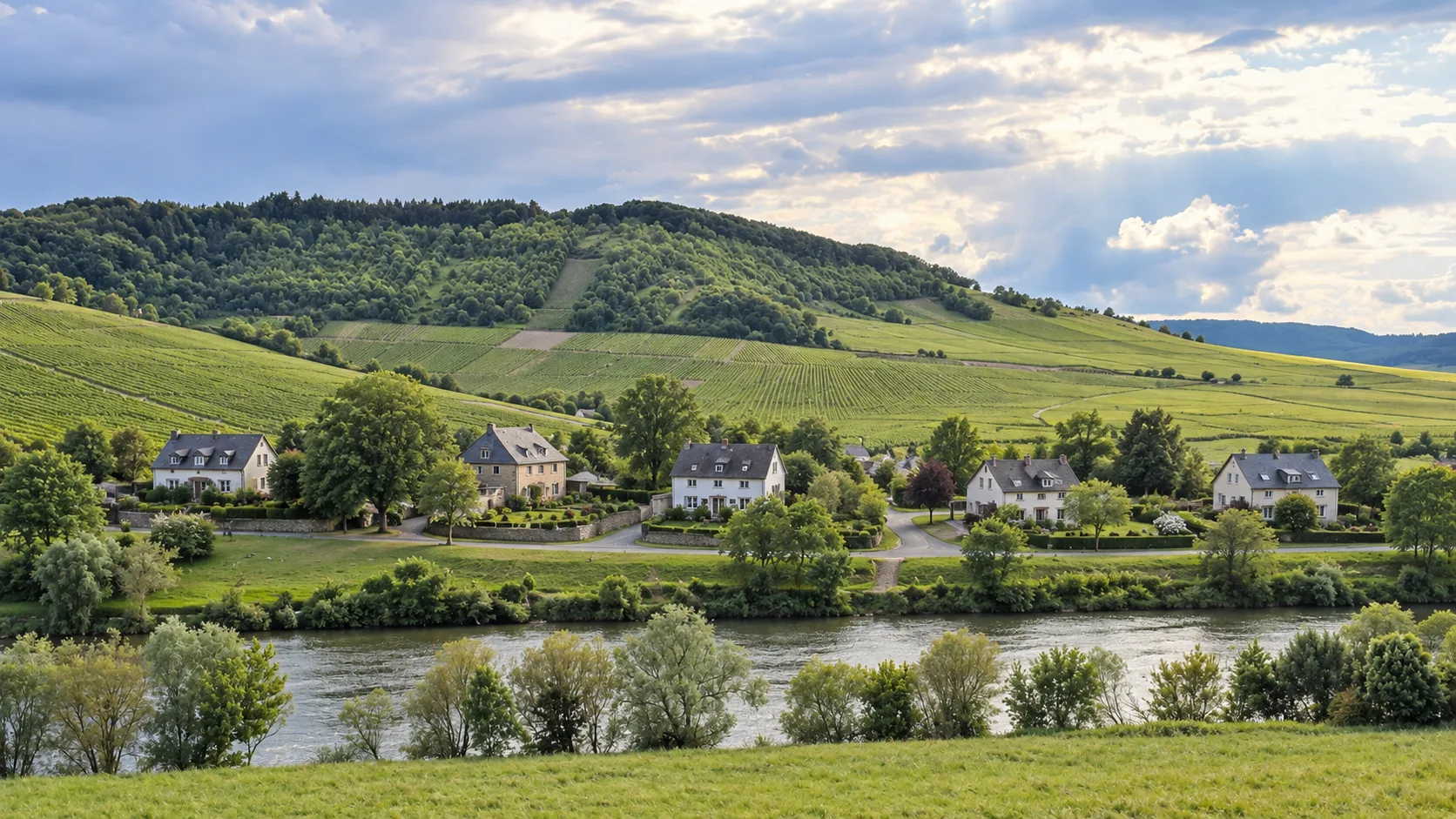
Before we approach a building, the eye first meets the larger forms around it: rising and descending land, open ground, water, and the routes by which the place is reached. A house may appear to be the obvious subject, yet it already occupies one position within a much wider setting.
In Traditional Feng Shui, mountains and water are not examined only as scenery. Their form, position, scale, and movement help establish the conditions through which Qi approaches, gathers, settles, or disperses. A building cannot be separated from these conditions simply because walls have been placed around it.
Feng Shui assessment therefore begins by widening the field of observation. Before asking what happens inside a building, it first asks what kind of environment the building belongs to and how that environment has formed the site on which it stands.
How a Landscape Forms a Setting
Seen from farther away, a landscape may first appear as a broad arrangement of higher and lower ground, slopes, openings, and water. As we look more closely, these forms begin to reveal how a place is structured.
Rising ground may shelter an area or give definition to the wider setting. A slope may direct approach, water, and movement toward lower ground. Openings between surrounding forms may connect one part of the landscape to another, while enclosed areas may slow and contain what reaches them.
In Feng Shui, these observations matter because environmental form influences the conditions under which Qi moves through a place. Terrain may allow Qi to approach and settle, guide it through an area, carry it away, or expose a location to movement that is too direct or forceful.
The effect of higher ground cannot be understood from height alone. At an appropriate distance, it may shelter and define the setting. When steep or disproportionately close, it may restrict approach and place sustained pressure upon the area below. A broad opening may create access and release, but without enough surrounding definition it may also allow movement to disperse before it can gather.
Water makes these relationships especially visible. A river may curve through the terrain, a stream may descend along a slope, or a lake may occupy a contained area of lower ground. Feng Shui examines how the water approaches, where it turns, how quickly it moves, whether it passes or settles, and how its scale relates to the surrounding land.
Water is important not merely because it is present. It reveals and influences patterns of movement, gathering, and dispersal associated with Qi. Water that curves or slows within a well-formed setting may help establish conditions in which Qi can settle. Water that moves too rapidly or too directly may carry those conditions past an area before they can be retained.
Stillness alone is not a negative quality. Calm or contained water may remain vital when it is clean, renewed, and appropriately related to its setting. Stagnant or deteriorating water is different. Water that is polluted, foul, decaying, or deprived of renewal indicates decline rather than stable gathering and is generally regarded as unfavorable to the surrounding site.
Landform and water are therefore read together. They establish boundaries, routes of approach, areas of shelter, and patterns through which Qi is directed or dispersed. Yet the wider landscape alone does not tell us the condition of a particular site. To understand that, we must move closer and ask where the site stands within these larger relationships.
Finding the Site Within the Landscape
As attention narrows, the question changes. We are no longer looking only at the landscape as a whole. We begin to ask where the site sits within it.
A site beneath rising ground, beside a slope, near a widening of the terrain, or at the mouth of an opening will not receive the same conditions. Its position affects how movement approaches, whether surrounding forms provide shelter, and whether Qi can gather without becoming blocked or dispersed.
Containment is an important part of this assessment. It does not mean that a site should be enclosed on every side. The surrounding environment should provide enough definition to shelter and retain Qi while still allowing renewal and movement.
Visible enclosure may contribute to containment, but enclosure that is too close, high, or complete can produce compression rather than support. In the same way, a slope or larger form may provide useful backing at one distance and become imposing at another. Support is not a permanent quality of an object. It is the result of a proportionate relationship between that form and the site.
Openness also changes according to scale. An open area may give approaching Qi room to slow, distribute, and gather before reaching the site more directly. If the opening is too broad or insufficiently defined, however, it may leave the site exposed and allow movement to pass through without settling.
Traditional Feng Shui describes an important receiving space of this kind as Ming Tang (明堂, traditionally “Bright Hall”). Ming Tang is the open spatial field associated with a site or building where approaching Qi can be received, moderated, and gathered.
A Ming Tang may be formed by open ground, a widening in the terrain, the relationship between land and water, or other surrounding forms that create space before the site. Its importance lies not simply in providing an open view, but in establishing a transition between the wider environment and the building.
A larger Ming Tang is not automatically more favorable. Its scale must be proportionate to the site, and its openness must be sufficiently defined to receive Qi without becoming exposed. A broad but uncontained space may encourage dispersal, while a more modest but clearly formed Ming Tang may provide a stronger field of reception and gathering.
At this stage, Feng Shui assessment begins to move from observation toward judgment. A hill, body of water, or opening does not carry a fixed meaning on its own. Its significance emerges from its position, distance, scale, and effect upon the particular site.
In a city, the visible forms change, but these questions remain.
When the Landscape Becomes Urban
As the view moves into an urban environment, ridges and waterways may recede from sight. Streets begin to carry movement across the ground, while rows of buildings define what is open, enclosed, sheltered, or pressed.
Roads are sometimes interpreted by analogy with water. The comparison concerns form and movement: how a road approaches, passes, curves, converges, or moves away from a site, and how its width, speed, distance, and alignment intensify or moderate those conditions. In urban Feng Shui, roads matter because they influence how movement and Qi approach, pass, concentrate, or disperse around a site.
A road passing beside or in front of a site may provide access and connection. When movement approaches gradually and the building has sufficient setback or a well-formed Ming Tang, the site may receive that activity without being overwhelmed by it. A wide or fast road placed too close to the building creates a different condition. Movement passes continually, leaving little opportunity for Qi to slow and settle around the site.
Curving roads also need to be read in relation to position. A bend may guide movement toward an area, carry it around the site, or turn away before a meaningful relationship is formed. On another part of the same curve, the direction of movement may place concentrated pressure upon the site. The curve itself is not the judgment; the question is how its form directs movement in relation to the site.
Intersections make these relationships more concentrated. Several roads meeting near a site may increase access, visibility, and activity. Such conditions may support certain commercial uses, while creating excessive exposure and disturbance for a residence that requires greater stability.
A T-junction provides a clear example of how road form becomes a Feng Shui condition. When a road terminates directly toward a site, movement is concentrated along a single axis rather than passing from the side. If the road is long, broad, fast, and closely aligned with the building or its entrance, the site may be subjected to direct exposure and repeated disturbance.
The condition becomes more severe where there is little setback, no effective Ming Tang, or no intervening form to slow the approach. In Feng Shui terms, the site has difficulty receiving and moderating the incoming movement before it reaches the building.
The name T-junction is only the beginning of the assessment. A narrow residential lane carrying slow movement does not impose the same condition as a major road directed toward the same position. Road width, speed, distance, changes in level, building alignment, and the space before the entrance all alter the consequence.
Where movement is strongly concentrated upon a building, the condition is generally unfavorable. Relational assessment explains why the influence is stronger in some settings and weaker in others.
Neighboring buildings also shape urban Feng Shui. Their height, mass, distance, and position may define open space, shelter a site, obstruct approach, or create sustained pressure. Their spatial effects can sometimes be compared with surrounding natural forms, although the comparison is functional rather than literal.
A proportionate building mass at a suitable distance may help contain and shelter a smaller site. A much larger structure placed too close may reduce openness, dominate the surrounding scale, or prevent Qi from approaching and circulating effectively. Gaps between buildings may create access and release, while a narrow opening between imposing masses may direct movement too sharply toward a smaller building.
Urban Feng Shui therefore observes more than traffic function or building density. It asks how roads and built forms organize the external Qi conditions of a site: whether they connect or bypass it, shelter or compress it, allow movement to gather, or direct it too forcefully toward the building.
The next question is no longer simply what surrounds the site, but how one particular building receives these conditions.
How the Building Receives Its Surroundings
At the scale of the individual building, position becomes more specific. Setback, entrance, form, and orientation determine which parts of the surrounding environment the building faces and how those conditions reach it.
The entrance is one of the principal points through which a building begins to receive the Qi conditions formed across the site. It connects the building to roads, open space, the Ming Tang, and the approach created by surrounding forms.
An entrance reached gradually across a proportionate setback may receive movement in a moderated way. An entrance placed directly on a road axis may encounter the same movement before it has had space to slow, turn, or distribute. The entrance does not create the external condition, but it affects how directly the building receives it.
The Ming Tang must therefore be understood in relation to the building it serves. An open area may appear adequate at the scale of the site yet fail to form an effective receiving field if the entrance is poorly positioned or remains directly exposed. A smaller but more clearly defined Ming Tang may perform its function more effectively because its scale and approach are better related to the building.
Orientation further changes this relationship. The same road may lie before one building and beside another. A neighboring structure may shelter one side of a building while obstructing another. An opening between buildings may provide access for one entrance but direct movement too sharply toward a differently oriented building nearby.
Orientation here refers to the fundamental question of which environmental conditions the building faces, receives, or turns away from. A complete compass or time-based analysis belongs to a later stage of assessment.
Consider two buildings on the same street. One is set back far enough for movement from the road to pass through a defined open space before reaching its entrance. The other stands closer to the road and nearer the axis of an approaching street. Although both belong to the same district, they do not receive the street in the same way.
The first building has more opportunity to moderate the movement that reaches it. The second is more directly exposed to concentrated approach. The difference does not arise from the road alone, but from the relationship among road form, setback, Ming Tang, entrance, and orientation.
This is why surroundings do not act upon a building in the abstract. Feng Shui moves from the wider environment to the site and then to the particular way a building receives what surrounds it.
From Observation to Judgment
Observation becomes Feng Shui assessment when an environmental condition is interpreted according to what it enables or prevents.
A favorable site is one in which Qi can be received, sheltered, gathered, and renewed without becoming stagnant or overwhelmed. Movement can approach without striking the building too abruptly. Open space provides reception without excessive exposure. Surrounding forms offer definition and support without compression.
Unfavorable conditions interfere with these functions. Repeatedly concentrated movement may disturb the site. Excessive openness may prevent Qi from settling. Large or closely placed forms may impose pressure and restrict approach. Deteriorating water or neglected surroundings may introduce conditions of stagnation and decline.
These judgments concern the functioning of the site and building. They ask whether the external environment supports stable occupation, whether Qi can gather and circulate, and whether the building must continually resist disturbance, dispersal, or pressure.
The intended use of the building also matters. Visibility and concentrated activity may support a shop, restaurant, or public entrance. The same conditions may be disruptive for a residence that requires greater stability and privacy. A quiet and contained setting may support domestic life while providing insufficient presence for some commercial uses.
Personal experience may offer clues. A sense of pressure, exposure, ease, or protection can draw attention to something in the environment. Feng Shui then asks what produces that response: scale, distance, movement, obstruction, enclosure, or the directness of approach. Feeling can alert observation, but the judgment must return to the spatial conditions that consistently affect the site.
Traditional Feng Shui recognizes recurring favorable patterns, including well-formed Ming Tang spaces, proportionate surrounding support, and water that gathers without stagnating. Their value lies in the relationships they create rather than in isolated objects or formulas that can be transferred unchanged from one setting to another.
Assessment therefore proceeds from observable condition to Feng Shui interpretation and consequence. It asks what the environment allows the site to receive, what it helps the building sustain, and what pressures or limitations are already present before attention turns inward.
Before the Assessment Moves Inside
By the time we reach the entrance, the building is no longer an isolated object. The wider landscape or urban setting has already shaped the routes by which Qi approaches, the areas in which it may gather, and the forms that shelter, expose, or press upon the site.
Internal organization can influence how these conditions are received, directed, distributed, or intensified. It can help a building work more effectively within its setting, but it cannot erase the larger environment in which the building stands.
At the threshold, the direction of assessment changes. The question is no longer how the surrounding environment reaches the building, but what happens after those conditions enter: how the building’s internal organization receives, guides, gathers, or obstructs them.
What Are the Five Phases in Traditional Feng Shui?
September 29, 2026Uncategorized
Why Are They Called the Five Phases?
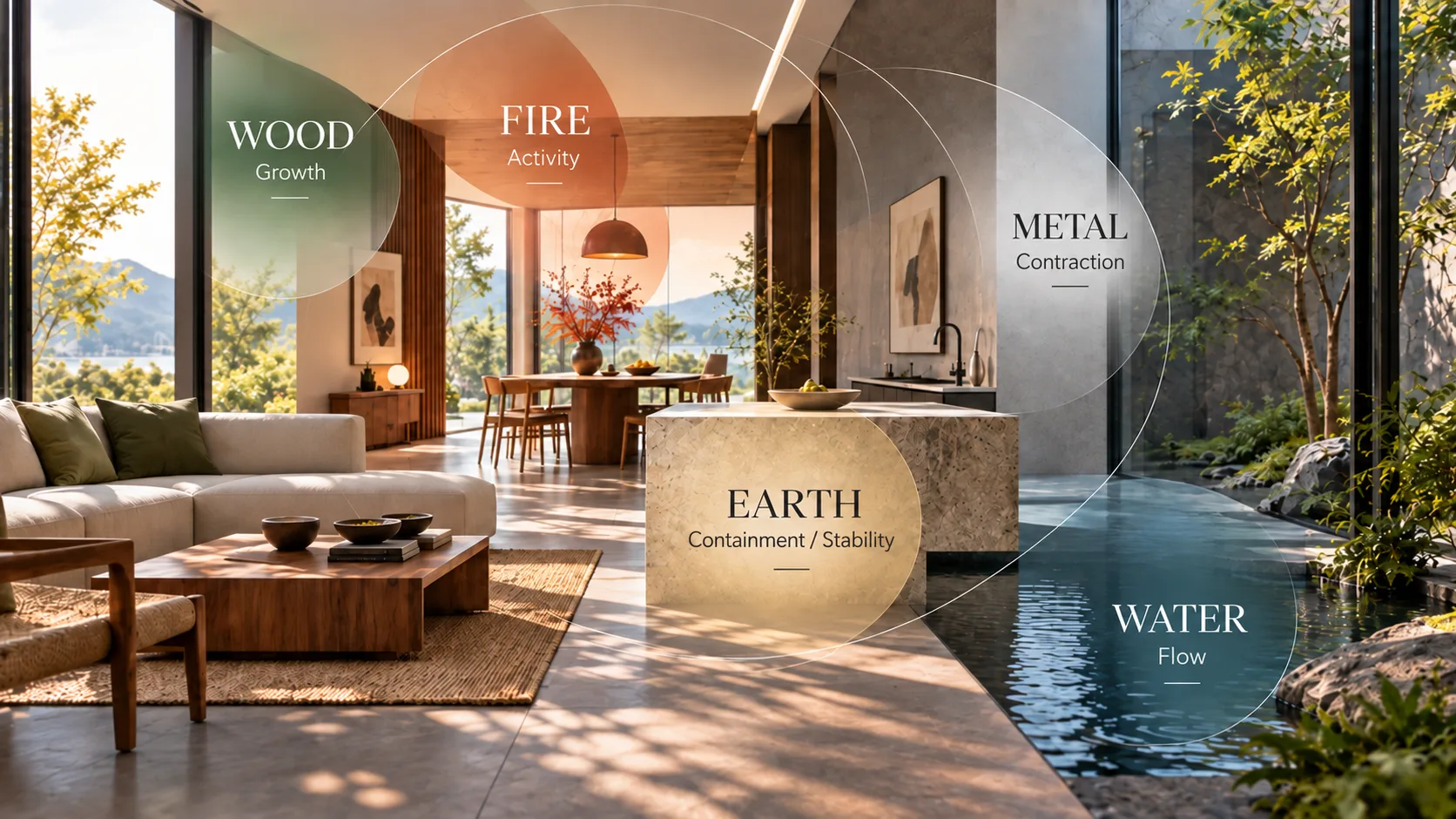
Wood, Fire, Earth, Metal, and Water are widely known in English as the Five Elements. This familiar term reflects the fact that the system takes its names and basic images from five recognizable materials.
Yet the word element can also suggest a fixed substance—one of a small number of materials from which everything else is made. This does not fully express how Wood, Fire, Earth, Metal, and Water are understood in Traditional Feng Shui. Their physical qualities provide the starting point, but the system is not limited to the materials themselves.
The term Five Phases (Five Elements) retains the familiar English name while better expressing a system understood through activity, relationships, and change.
From Familiar Materials to Wider Patterns
The names Wood, Fire, Earth, Metal, and Water are not arbitrary symbols. Each begins with qualities that can be observed directly. Wood grows and extends. Fire rises, gives off heat and light, and spreads. Earth supports and contains. Metal is hard, sharp, and contracting. Water moves downward and follows available paths.
In the Five Phases, these familiar qualities extend beyond the materials themselves. They become a way of recognizing recurring tendencies such as growth, expansion, stability, contraction, and flow, together with the relationships and changes that arise among them.
Analogy allows different phenomena to be connected through shared qualities. These correspondences are based on established characteristics and relationships rather than superficial resemblance alone.
How the Five Phases Relate to Qi and Yin–Yang
In Traditional Feng Shui, Qi, Yin–Yang, and the Five Phases offer related ways of understanding a place.
Qi helps Feng Shui recognize what is active within a place—how influences move, gather, disperse, and interact. Yin–Yang distinguishes broad relative qualities within this activity, such as active and quiet, or bright and dark.
The Five Phases provide a more differentiated language. They distinguish more specific tendencies and describe how these tendencies support, regulate, and respond to one another. They do not divide Qi into five separate kinds of energy, nor do they replace Yin–Yang.
Together, these concepts allow Traditional Feng Shui first to recognize the activity present in a place, then to distinguish its broad relative qualities, and finally to understand its more specific characteristics and relationships.
The Character of Wood, Fire, Earth, Metal, and Water
Each phase takes its basic character from the observable qualities of its corresponding material.
Wood is associated with growth, extension, and development. A plant rises from the ground, bends around obstacles, and spreads outward as it develops. Wood therefore includes both rising and curving movement.
Fire is associated with heat, light, upward movement, and rapid activity. A flame rises, spreads when conditions allow, and can change its surroundings quickly.
Earth receives, contains, and provides stability. It provides a stable basis that can hold and sustain what rests within it. Earth is closely associated with steadiness, containment, and the capacity to support what is present.
Metal is associated with hardness, sharpness, coldness, and contraction. Its sharpness allows it to cut and separate, while its cold quality is associated with drawing inward. These qualities give Metal a clear and decisive character.
Water moves downward and follows the paths available to it. It flows around obstacles, penetrates openings, and adapts to the terrain it crosses or the container that holds it. Water is therefore associated with flow, flexibility, penetration, and adaptation.
The character of each phase becomes clearer through its relationships with the others—through the ways they support, restrain, and respond to one another.
How the Five Phases Generate and Control One Another
Two of the most important relationships among the Five Phases are the generating cycle and the controlling cycle.
In the generating cycle, Wood generates Fire, Fire generates Earth, Earth generates Metal, Metal generates Water, and Water generates Wood. This sequence describes how one phase produces, supports, or provides conditions for another. Wood can feed Fire, and Water allows Wood to grow. Each link expresses support in a different way, and together they form the traditional generating sequence.
The generating relationship is not automatically favorable. Support may strengthen a phase that is already excessive, while too little support may leave another unable to develop. Its meaning depends on the condition being considered and on the wider relationship among the phases.
The controlling cycle follows a different sequence: Wood controls Earth, Earth controls Water, Water controls Fire, Fire controls Metal, and Metal controls Wood. Here, control does not simply mean destruction. It describes restraint, regulation, and the prevention of unlimited development. Water can restrain Fire, Metal can cut Wood, and Earth can contain or direct Water.
Control is therefore not automatically unfavorable. Without restraint, one tendency may grow beyond an appropriate degree or overwhelm the others. Generation allows activity to continue and develop; control places limits on that development and helps regulate its strength.
Balance depends on the relationships among the phases, not on making them equal. A strong expression of one phase may be suitable in one situation and excessive in another. Traditional Feng Shui therefore considers the whole relationship rather than judging a phase by its presence alone.
How the Five Phases Are Recognized in Feng Shui
Traditional Feng Shui recognizes the Five Phases through a set of correspondences linking direction, season, external form, color, and material.
The most familiar associations link Wood with the East and spring, Fire with the South and summer, Metal with the West and autumn, and Water with the North and winter. Earth is associated with the center and commonly with late summer, while some traditional arrangements also connect it with the transitions between seasons. These relationships allow the Five Phases to describe both spatial order and recurring change through time.
Five Phase qualities are also recognized in the forms of mountains, waterways, and distinctive buildings. A pointed or sharply rising outline may be classified as Fire, while a rounded or domed form may be classified as Metal. Other forms may be approached through the same principle, beginning with their dominant outline and overall character.
Within an interior, color offers a readily recognizable set of Five Phase correspondences. Green and blue-green are associated with Wood; red and purple with Fire; yellow and earth tones with Earth; white, grey, and metallic tones with Metal; and black or dark blue with Water.
Materials may also carry clear Five Phase associations. Wood and plant materials correspond to Wood; stone, clay, and brick to Earth; metals to Metal; and water itself to Water. Flame and sources of noticeable heat or light carry Fire correspondences.
Taken individually, these correspondences do not complete a Feng Shui judgment. The significance of a form, color, or material depends on where it appears, how prominent it is, and how it relates to the wider conditions of the place. Five Phase balance is not created by simply adding colors, materials, or symbolic objects associated with all five phases to every room.
Direction, form, color, and material become meaningful not as isolated symbols, but as parts of a wider assessment of the place. This is how the Five Phases function in Feng Shui: by organizing relationships within an observed environment rather than judging individual features in isolation.
What Is Yin–Yang in Traditional Feng Shui?
September 29, 2026Uncategorized
What Yin and Yang Mean in Traditional Feng Shui
Yin and Yang are among the most familiar ideas in Chinese thought, yet they are also easily misunderstood. They are often described as two kinds of energy, as though they were separate forces acting against one another. This can be misleading. Yin and Yang are better understood as relative qualities expressed within a single whole.
In traditional Chinese thought, Yin and Yang arise within Taiji, a unified whole rather than two separate forces.
Traditional Feng Shui uses this framework in a practical way. It observes how Yin and Yang appear in the actual conditions of a place and considers whether those conditions support the way the place is meant to be used.
Yin and Yang Are Relative
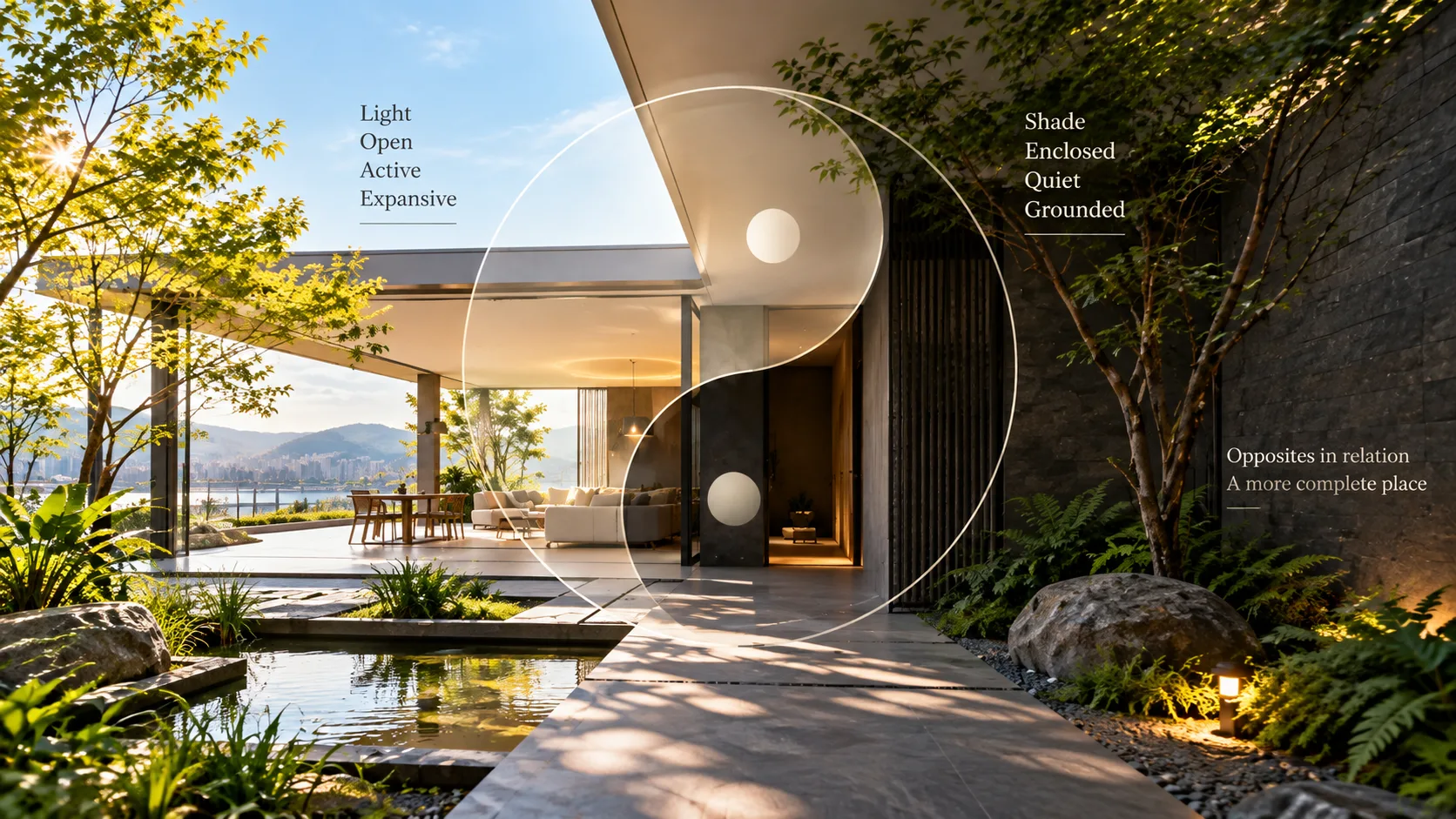
Yin and Yang are not fixed labels attached permanently to things. A quality is understood as more Yin or more Yang only in relation to another condition. Brightness appears more Yang in relation to shade, while movement appears more Yang in relation to stillness. The same quality may therefore be understood differently when the surrounding conditions change.
This does not mean that Yin and Yang are opposing forces in conflict. They distinguish contrasting qualities, but each is understood through its relationship with the other. Light is more Yang in relation to shade, movement in relation to stillness, and openness in relation to enclosure.
For this reason, nothing is entirely or permanently Yin or Yang in every respect. Traditional Feng Shui compares the qualities actually present in a place rather than assigning it a single fixed label.
Reading Yin and Yang in the Natural Environment
Traditional Feng Shui begins with the observation of the natural environment. Mountains and water provide one of its clearest examples of Yin–Yang distinction. A mountain is generally more Yin in relation to moving water because it appears more stable and settled, while water is generally more Yang because of its movement and activity.
This does not mean that every mountain is simply Yin or every body of water is simply Yang. Mountain forms may appear quiet and contained, or they may rise, extend, and move strongly across the landscape. Water may flow rapidly, move gently, spread across an open surface, or remain enclosed within its surroundings. Their Yin–Yang character depends on how these conditions are actually expressed.
Other differences become visible across the same landscape. Sunlight may reach one part of a site while another remains shaded. Some areas are exposed to movement and activity, while others are sheltered by surrounding landforms and appear more settled. Feng Shui reads these relationships rather than treating particular objects as permanently Yin or Yang.
These differences are part of the broader conditions through which Qi is expressed in a place. Yin–Yang helps distinguish whether those conditions are more moving or still, open or enclosed, bright or shaded.
Buildings remain part of these environmental relationships. They receive light, wind, sound, movement, and protection from their surroundings, while their own form and openings shape how these conditions continue into the spaces within.
How Yin–Yang Conditions Support the Function of a Space
Within a building, different spaces receive and organize light, sound, movement, and enclosure in different ways. Traditional Feng Shui considers whether these qualities support what each space is intended to do.
A bedroom, for example, is primarily a place for sleep and recovery. It therefore benefits from a more Yin character: softer light, less activity, greater quiet, and a sense of stability and enclosure. These conditions help the room settle and support rest. Excessive brightness, exposure, noise, or movement may give the room a more Yang character than its function requires.
Yet a bedroom should not be made as Yin as possible. If it becomes excessively dark, closed, airless, or inactive, it may no longer provide healthy and usable conditions. A work area or a room used for social activity may need more daylight, movement, and connection, but continuous noise, exposure, or stimulation can also make it difficult to concentrate or settle. Yin and Yang are not good or bad in themselves. Their value depends on whether the conditions support the function of the space.
Feng Shui adjustment works by changing these observable conditions rather than by adding a mysterious Yin or Yang energy. A bedroom that is too bright or exposed may need greater softness, quiet, or enclosure. A room that is too dark and inactive may need more light, air, or movement. The aim is not to create equal amounts of Yin and Yang, but to adjust the conditions so that the space better supports its function.
The Yin–Yang condition of a room may also change over time. It may be brighter and more active during the day, then quieter and more enclosed at night. Changes in light, occupancy, activity, and use alter its condition even when the physical room remains the same.
From Yin–Yang to the Five Phases
Yin–Yang gives Traditional Feng Shui a basic way to distinguish the relative qualities present in a place. The Five Phases develop this understanding further by providing a more differentiated framework for describing patterns of activity, relationship, and change.
What Is Qi in Traditional Feng Shui?
September 29, 2026Uncategorized
Why “Energy” Is Only a Starting Point
Qi is often translated into English as “energy.” The word is useful because it suggests activity, influence, and change. It also helps explain why Qi appears in fields such as Traditional Chinese Medicine and Taiji, where it is understood in relation to life, bodily function, and movement. But “energy” is only a bridge. In modern English, the word often suggests something measurable, transferable, or stored like a physical substance. Qi has a broader meaning within traditional Chinese thought, and Feng Shui approaches it through a particular field of observation: the conditions of a place. Its meaning becomes clearer when we look at how land, water, buildings, boundaries, and spatial relationships create movement, protection, openness, continuity, and change.
Qi Is Understood Through a Place
Feng Shui does not understand a place as a collection of isolated objects. A mountain, a river, an open field, a road, or a building acquires meaning through its relationship with everything around it. The direction of the land, the way water approaches and leaves, the degree of exposure or protection, and the boundaries that hold a place together all contribute to its particular condition. Qi is understood through these relationships. It is not identical to the visible forms of the environment, yet it is not considered apart from them. Feng Shui begins with the place itself and asks how its conditions connect: whether movement continues or is interrupted, whether a site is open or contained, and whether what reaches it can remain or is quickly dispersed. This is why the same physical feature cannot be given a fixed Feng Shui meaning in isolation. Water may strengthen one place and weaken another, depending on its direction, speed, form, and relationship to the surrounding land. An open view may bring space and clarity, while excessive exposure may leave a site without protection. Through Qi, Feng Shui interprets this active dimension of place—how conditions influence one another and what they make possible.
How Qi Moves Through a Landscape
The movement of Qi becomes clearest in a landscape. A mountain range does not stand as a series of unrelated peaks. It rises, descends, turns, divides, and continues across the land. Rivers also have a course: they approach from somewhere, respond to the terrain, curve or rush forward, join other waters, and eventually leave. Feng Shui reads these movements as parts of a larger environmental pattern. Where the land develops through a clear connection from one formation to the next, Qi is understood to move with that larger progression. Where the terrain is abruptly severed, broken, or left without support, that continuity may weaken. The concern is not only the appearance of an individual mountain or river, but whether the landscape carries movement forward as a connected whole. Water makes this dynamic especially visible. A river that bends through the land creates a different relationship from one that cuts directly past a site or rushes away without turning. Its speed, direction, width, and connection with the surrounding terrain all affect how the place is understood. Water does not stand for Qi, nor does Qi move exactly like water. The course of water instead helps reveal direction, convergence, separation, and departure within the landscape. The degree of openness also matters. A site exposed to strong wind and lacking surrounding support may have difficulty retaining what reaches it. A place with appropriate protection can receive movement without immediately losing its form. Yet protection is not complete enclosure. A landscape still needs connection, openness, and room for renewal. This is the more precise meaning behind the familiar expression “Qi flow.” In Feng Shui, it refers less to an invisible current than to the way terrain, water, exposure, and surrounding forms create continuity, direction, convergence, and change.
How Qi Comes to Rest, Gathers, or Disperses
Movement alone does not create a favorable place. If the conditions of a landscape carry everything onward without pause, Qi may continue past a site rather than become established there. Feng Shui therefore considers not only where movement comes from, but whether it can slow, turn, and find an appropriate place to settle. A classical Feng Shui principle describes Qi as dispersing when overly exposed to wind and coming to rest where water helps define the landscape. It directs attention to the relationship among exposure, terrain, and water: whether a place can receive movement, retain it, or allow it to pass away. Water is especially important in this transition. Where it meets the land, curves around it, or marks a change in direction, the larger movement of the landscape may also begin to gather. Yet water alone is never enough. A fast, direct current that rushes away may draw conditions outward, while water that relates more gently to the surrounding land may help create convergence and containment. The land around a site must also participate. Surrounding forms can protect what arrives, define an open centre, and reduce excessive exposure. If everything is tightly enclosed, however, the place may lose connection and renewal. If it is too open, nothing holds together. Gathering depends on a proportionate relationship between movement and rest, openness and protection. Qi gathering is therefore not the absence of movement. It is a condition in which what reaches a place can settle, remain connected, and continue to support life rather than immediately dispersing.
From Landscape to the Home
A house does not stand apart from the landscape principles through which Feng Shui first understood Qi. Even in a city, the ground beneath a building, the roads and structures around it, the direction of approach, and the degree of exposure or protection form the larger setting of the home. The building adds another layer through its orientation, entrances, walls, openings, and internal arrangement. A building does more than enclose space. It reorganizes movement and connection. Its entrance determines how the home meets its surroundings. Walls and neighbouring structures create protection, obstruction, or pressure. Doors, windows, passages, and rooms connect the exterior with the interior and one part of the home with another. Gathering Qi in a home depends on how these conditions work together across different scales. The surrounding environment, the building, and the internal arrangement form one continuous relationship. A home is not understood only from what happens inside its rooms, nor only from the quality of its external setting. Its Feng Shui emerges from how these layers support or disrupt one another. For this reason, gathering Qi is not the accumulation of an invisible quantity inside a room. It is the result of appropriate Feng Shui conditions coming together—from the natural and urban surroundings to the building and the organization of the living space. When these layers work together, movement can enter without immediately rushing away, important spaces can remain connected without being constantly disturbed, and the home can support both activity and rest. Such gathering is not created by sealing a home or preventing movement. A space with no openness, exchange, or renewal may be enclosed without being alive. Nor does constant movement necessarily produce vitality. A home in which every route is exposed, hurried, or pulled outward may fail to settle even when it is bright and well ventilated. The difference between gathering and stagnation lies less in whether movement exists than in what the whole arrangement is capable of supporting. Gathering allows the conditions of a place to become connected and life-supporting. Stagnation appears when those conditions fail to sustain vitality, use, and renewal—whether the space is closed and lifeless or active without ever becoming settled.
What Kind of Qi Is Being Gathered?
Yet coherence alone does not tell us what quality of Qi has gathered. A place may be enclosed, protected, or strongly centred and still feel depleted, harsh, or unable to support continued growth. Qi names the broader activity and condition expressed through a place. To speak of gathering is to ask whether those conditions can settle and remain rather than disperse. Sheng Qi adds another question: does what gathers possess a generative, nourishing, and life-supporting quality? Vitality is closely associated with Qi, but it does not define the concept as a whole. Qi may be forceful without being nourishing, or settled without being alive. Feng Shui does not seek simply stronger Qi or a greater quantity of it. It seeks conditions in which Sheng Qi can gather and continue to support life, development, and renewal. People may respond to these differences before they can explain them. A place may seem lively, stable, oppressive, unsettled, or depleted. Such responses can offer a clue, but they do not by themselves define the Qi of the place. Feng Shui returns to the environment—its land, water, buildings, boundaries, and spatial relationships—to understand what may be producing that experience. The question is not only whether Qi gathers, but what quality of Qi the place is able to receive, hold, and sustain.
Qi Within the Larger Feng Shui Framework
Qi is foundational to Traditional Feng Shui, but it does not explain every quality of a place by itself. Yin–Yang helps Feng Shui understand relative conditions and change, while the Five Phases describe recurring patterns of activity, relationship, and transformation. Neither should be reduced to separate kinds of Qi. Together, these frameworks allow Feng Shui to move beyond the idea that a place simply has more or less energy. The concern is how its conditions relate, what kind of movement and vitality they produce, and whether they can support life in a coherent and continuing way. To understand Qi in Feng Shui is to begin reading a place as an active field of relationships. Land, water, buildings, boundaries, openings, and spatial arrangements do not operate separately. Together they shape how movement continues, where it settles, what can gather, and what kind of life the place is able to sustain.
What Traditional Feng Shui Studies in Order to Understand a Place
September 29, 2026Uncategorized
A Place Is More Than a Collection of Objects
When Traditional Feng Shui examines a place, it does not assign fixed meanings to isolated features. A mountain, a road, an entrance, or a room cannot be understood in the same way wherever it appears. Its significance depends on where it is, what it faces, how close it is, and how it relates to everything around it.
A road near a house, for example, is not automatically favorable or unfavorable. Its direction, distance, width, level of movement, and relationship to the entrance all matter. Open space, vegetation, walls, or other buildings between the road and the house may also change how strongly it affects the site.
Traditional Feng Shui therefore looks not only at what is present, but at the pattern formed by different conditions. This is why the study of a place begins with its wider environment before moving inward toward the site, the building, and the organization of its internal space.
The Place, the Site, and Its Surroundings
Before a place can be assessed, it must first be clear what the subject of the assessment is. The place being studied may be a parcel of land, a house, an apartment, a building, a settlement, or a particular area within a larger property. Each subject requires a different scale of observation.
A house cannot be understood only through its rooms or exterior walls. Its position within the site, the space around it, nearby roads, neighboring buildings, changes in ground level, and the broader character of the area may all shape its Feng Shui conditions. The same house could be understood differently if it stood on another site or within a different environment.
The field of observation does not always end at the property line. Conditions immediately beside a site often have the most direct relationship to it, but larger or more distant features may still matter when they are prominent, exposed, or clearly aligned with the place.
Traditional Feng Shui moves between these different scales. It identifies the immediate subject, considers the site that contains it, and then looks outward to the surroundings that give it context.
Natural Landforms and Water
Traditional Feng Shui first developed through the observation of land and water. Before buildings and rooms are considered, the wider terrain establishes the physical setting in which a place exists. Mountains, slopes, valleys, plains, rivers, streams, and open ground all contribute to the larger conditions surrounding a site.
These features are studied not only for their appearance, but also for the movements and relationships they express. A mountain range may approach, continue, turn, rise, or descend. Land may open outward, narrow, enclose, or provide protection. Water may flow toward a place, curve around it, pass quickly, divide, collect, or move away.
The meaning of these forms depends on their relationship to the site. A high landform may offer protection in one position but create pressure or obstruction in another. Open ground may provide space and outlook, yet too much exposure may leave a site without sufficient support. Water may encourage movement and gathering under suitable conditions, while its speed, direction, scale, and distance may produce a different effect elsewhere.
This attention to land and water provides the foundation for later concepts such as the movement, gathering, dispersal, and vitality of Qi. At this stage, the essential point is simpler: Traditional Feng Shui begins by reading the larger patterns of the natural environment.
Orientation and Directional Relationships
Once the wider setting is understood, the next question is how the site or building is oriented within it. Orientation is not only a compass direction. It describes how a place is positioned in relation to what surrounds it.
A building has a front and a back, areas of greater openness and protection, and particular directions from which roads, wind, light, views, people, or other conditions approach. Entrances and major openings connect some parts of the surroundings to the building more directly than others.
The same external feature may therefore take on a different significance depending on whether it lies in front of the building, behind it, beside it, or along the direction of approach. An open view in front of a house creates a different relationship from the same degree of openness behind it. A nearby road, body of water, large building, or elevated landform must also be understood according to its direction and position relative to the site.
Compass measurements and directional systems later make these relationships more precise, but they do not replace the physical setting. At the most basic level, orientation matters because it connects a site or building to actual features in its environment.
Buildings between Site and Interior
Orientation establishes how a building faces its surroundings. The building’s own placement, form, scale, and openings determine how that relationship is physically expressed.
A building does not stand apart from the land around it. Its position on the site may affect how much protection, openness, movement, or exposure it receives from nearby landforms, roads, water, and other structures. Entrances, windows, courtyards, and major openings create more specific connections between exterior and interior.
The form of the building also matters. Height, width, mass, projections, recesses, and the arrangement of different parts influence how the building occupies the site and how its spaces are enclosed or exposed. Two buildings with the same facing direction may therefore have different Feng Shui conditions because their forms, openings, and positions are not the same.
A building stands between the larger environment and the spaces in which people live or work. It receives conditions from outside and reshapes them through its physical structure.
Internal Spatial Organization
Within a building, Traditional Feng Shui examines how space is divided, connected, and used. Rooms and functional areas matter, but their Feng Shui conditions do not arise from their names alone. What matters is how each area is formed and how it relates to the rest of the building.
Walls and boundaries create enclosure and separation. Doors, windows, and other openings connect one area to another or link the interior to the outside. Corridors, stairs, and passages shape movement through the building, while the size and position of openings influence which areas are more exposed, protected, open, or contained.
Changing the stated use of a room does not automatically change its Feng Shui conditions. A room does not become different simply because it is renamed as a bedroom, study, or office. A physical alteration—such as moving a wall, adding or closing an opening, redirecting circulation, or changing the connection between two areas—may have a more direct effect because it changes the organization of the space itself.
The interior still belongs to the larger structure of the building. The location of entrances, the direction of major openings, and the relationship between internal areas remain connected to the building’s orientation, site, and external setting.
A Place Also Exists through Time
Spatial organization describes a place at a particular moment, but Traditional Feng Shui does not assume that those conditions remain unchanged.
Land, surroundings, buildings, and patterns of use may remain stable for long periods, yet they can also change. A new road or neighboring building may alter access, movement, exposure, or protection. A river may shift course, vegetation may grow or disappear, and a building may be extended, renovated, or opened in a different way.
Even when the address remains the same, the relationships that define the place may no longer be identical.
Time also matters because some conditions are temporary while others become part of the established environment. Construction work may create a short-term disturbance, whereas a large building that permanently blocks an opening changes the setting more continuously. How long a condition lasts, whether it repeats, and whether it becomes stable all influence its significance.
Traditional Feng Shui also developed systems for studying how the meaning and influence of a place may vary across different periods. Those methods belong to later study. The basic principle is that a place is understood not only through its arrangement in space, but also through the way its conditions continue and change over time.
Who Uses the Place, and How Are They Affected?
To understand the significance of these conditions, Traditional Feng Shui also considers who uses the place and how it is used.
A house, workplace, shop, school, or temporary lodging may contain similar physical features, but the activities carried out there and the length of time people remain within them are different. A passage crossed only briefly does not have the same importance as a bedroom, desk, or work area occupied for many hours each day.
Some people may use one part of a building regularly, while others rarely enter it. Feng Shui therefore considers where people sleep, work, rest, gather, or move through the space, as well as how frequently and for how long they are exposed to its conditions.
A place may affect people through the ways it supports, restricts, exposes, separates, or connects their activities. A sleeping area, for example, may be influenced by its degree of enclosure, nearby movement, openings, and relationship to adjoining spaces. These conditions are considered together with the wider setting of the building rather than treated as isolated room features.
People may also notice a place through feelings such as comfort, pressure, restlessness, or ease. These responses can draw attention to conditions worth examining, but they do not establish a Feng Shui judgment by themselves. Assessment still returns to the physical and spatial conditions of the place, the people who use it, and the length and frequency of their exposure.
Bringing the Conditions Together
These different observations become meaningful only when their relationships are considered together.
A condition must first be understood in relation to a particular subject. A road may be close to a property but far from the building itself. A large opening may connect one room directly to an exposed exterior condition, while another part of the same building remains protected. A feature may appear prominent when viewed alone but have less influence once distance, proportion, intervening space, or other forms of buffering are considered.
Strength and duration also matter. A large structure directly facing a site may have a different significance from a smaller one farther away. A temporary obstruction does not carry the same weight as a permanent change. A condition affecting a frequently used room may be more relevant to daily life than one affecting a rarely occupied area.
Traditional Feng Shui therefore asks several questions at once: What is the subject? How do surrounding conditions correspond to it? How near or strong are they? How long do they persist? What lies between them? And how do they contribute to the overall pattern?
The final judgment comes from these combined relationships rather than from any single feature.
From the Larger Environment Inward
Traditional Feng Shui understands a place by moving from the larger environment inward. It begins with the wider setting, then considers the site, landforms and water, orientation, the building, and the organization of its internal spaces. Time and human use are added to this spatial picture so that the place is not treated as static or separate from daily life.
This order provides a structure for observation, but it is not a rigid sequence. A building’s orientation must be understood in relation to its surroundings. Internal spaces depend partly on the form and openings of the building. Changes outside may alter conditions within, while patterns of use may determine which conditions deserve the greatest attention.
The purpose of this article is not to teach a complete Feng Shui judgment. It is to show the range of conditions that Traditional Feng Shui studies before reaching one.
A place is understood through the pattern formed by its environment, orientation, physical structure, changes through time, and the lives carried on within it. Later articles can examine each of these areas more deeply, but they remain parts of the same whole.
The History of Feng Shui
September 29, 2026Uncategorized
1. A Poem About Choosing a Place
In an ancient poem preserved in the Classic of Poetry, Gong Liu leads his people in search of a place where they can settle. The poem belongs to one of China’s oldest surviving collections of verse, whose works largely date from the eleventh to the fifth centuries BCE. Gong Liu himself appears as a traditional ancestor of the Zhou ruling house.
The poem follows him across the land. He climbs to higher ground, returns to the plains, and considers whether the territory can support cultivation and a settled community. He does not treat the place as an empty piece of ground. Its slopes, open areas, water, and exposure to sunlight all matter.
At one point, the poem says that he assessed the land’s “Yin and Yang” and observed its flowing springs. Here, Yin and Yang refer first to the shaded and sun-facing aspects of the land: which parts received more sunlight, which remained cooler, and how the terrain faced its surroundings. The springs also mattered as practical conditions of settlement, providing water for cultivation and everyday life.
This scene preserves an early picture of people reading the conditions of land before deciding where and how a community would live. The poem does not present a developed system under the name Feng Shui. Instead, it shows the kinds of questions from which that tradition would gradually grow: What was the land like? Where did water flow? Which areas received sun or remained in shade? Could the place sustain people over time?
Such questions later appeared in relation not only to settlements, but also to capitals, dwellings, and burial places. They were expressed through different practices and names long before Feng Shui became the familiar term for the larger tradition.
2. Before It Was Called Feng Shui
In an early account of the founding of Luoyi, the future site of the capital was first examined and then submitted to divination. Only after the result was accepted did planning and construction begin.
Early texts described the examination of land or a settlement site as xiangdi or xiangzhai. Divination used to confirm the choice was called buzhai. Practical assessment and ritual confirmation could therefore belong to the same process without being the same act.
Another early technical term was Kanyu, associated with relationships between Heaven and Earth, timing, and systems of divinatory calculation. Its early meanings were not identical to everything later understood as Feng Shui, but over time Kanyu became another name for the wider tradition.
These were not successive names for a single, already complete system. Each addressed a different part of choosing and interpreting a place—examining the land, confirming a decision, considering time, or relating human action to wider patterns of Heaven and Earth. Together, they reveal several of the practices from which the later Feng Shui tradition developed.
These practices were applied in different settings and for different purposes. Among the most important was the selection of places not only for the living, but also for the dead.
3. Places for the Living and the Dead
A place could be chosen for a settlement, a dwelling, or a grave. Each served a different purpose, but none was understood apart from the land around it. Terrain, water, orientation, and the position of a place within its surroundings could all matter.
For settlements and places where people lived, such judgments concerned whether the land could support shelter, cultivation, and daily life. Burial sites belonged to a different domain, yet they too were assessed through their relationship to the wider landscape. The two were not identical, but both formed part of the longer history of selecting and interpreting places.
This does not mean that Feng Shui began only as a burial practice. Concerns with settlements and dwellings were already present in early texts and continued alongside burial traditions. Burial nevertheless became especially important in the development of Feng Shui theory because later writings used burial-site selection to explain broader relationships between land and Qi.
This theoretical importance becomes especially clear in the Zangshu (the Book of Burial).
4. Guo Pu and the Zangshu
Traditionally attributed to Guo Pu (276–324 CE), the Zangshu begins with a concise proposition: burial depends upon receiving Sheng Qi. The surviving text became one of the most influential works in Feng Shui history, although its authorship and formation remain uncertain.
Its central idea is that Sheng Qi moves within the earth. Qi is therefore not presented as an atmosphere detached from physical place. It was understood through the configuration and larger movement of the land.
The text explains: “Qi is carried by wind and disperses; when bounded by water, it comes to rest.” The point is not that wind is always harmful or that the mere presence of water is favorable. What mattered was whether the conditions of the place allowed Qi to disperse or to come to rest.
The Zangshu continues by saying that the ancients sought to gather Qi so that it would not disperse and to guide its movement toward a place of rest. It is in this context that the text explains the name Feng Shui. The name therefore refers not simply to wind and water as objects, but to their relationship with how Qi moves, disperses, and comes to rest.
This became the most influential early textual explanation of the name Feng Shui. It does not establish that Guo Pu invented the term or that the whole tradition began with him; earlier texts had already described the assessment of settlements, dwellings, and other sites. Even so, later Feng Shui traditions came to regard him as a foundational figure because the text attributed to him gave lasting theoretical form to the relationship among burial, land, Qi, wind, and water.
Because Qi was understood to move through the earth, the visible configuration of the land became central to reading a place. This led Feng Shui practice toward the close observation of mountains, valleys, and watercourses.
5. Reading Mountains and Water
To read a landscape was to follow relationships across different scales. A mountain was considered not only by the shape seen from one position, but by its continuity, direction, and relationship to the surrounding land. Water was read in much the same way: where it came from, how it moved through the terrain, and where it turned, widened, narrowed, or continued beyond the place being considered.
This required attention to both the larger movement of the terrain and the local form found at a particular place. A ridge might extend across a broad region before approaching a valley or settlement, while a bend in a river gained meaning through its position within the wider landscape. The immediate form of a place was therefore read as part of a larger continuity.
In later Feng Shui history, this close reading of mountains and water became especially associated with Yang Yunsong, traditionally placed in the ninth century CE. Later tradition places him at the Tang court and tells that, during the upheavals of the late Tang period, he travelled south to Jiangxi. There he became associated with the study of local mountains and water, the teaching of disciples, and the use of Feng Shui within ordinary communities. Later generations called him “Yang the Rescuer of the Poor,” preserving the memory of specialized knowledge passing from the court into local life.
Yet visible landscape was only one part of Feng Shui assessment. A place also had orientation, and some methods interpreted its significance in relation to time. Direction, timing, and systems of calculation would become another major part of how places were understood.
6. Direction, Time, and the Compass
Orientation was more than a direction marked on a map. It described how a place faced and related to sunlight, wind, roads, water, and the surrounding land. Two buildings could stand within the same general landscape yet form different relationships with it because they faced different directions or occupied different positions.
Some Feng Shui methods also considered orientation in relation to time. The interpretation of a place was not always treated as permanently fixed, and the meaning assigned to a direction could vary within different temporal cycles. Approaches concerned with orientation, time, and related systems of interpretation came to be known as Li Qi. Depending on the method, they could draw on Yin–Yang, the Five Phases, trigrams, and cyclical systems of time.
Many Li Qi methods used the Feng Shui compass, or luopan. It served not only to establish direction, but also to organize layers of technical information around a measured orientation. The instrument was central to many Li Qi methods, but Li Qi itself referred to the wider work of interpreting orientation and time.
In modern English-language writing, different emphases within Feng Shui are often grouped under the labels “Form School” and “Compass School.” These familiar terms are useful, although incomplete. Form approaches included much more than the outward shape of an object: they considered terrain, mountains, watercourses, and spatial relationships. Compass approaches involved more than using an instrument: they interpreted orientation and time through broader systems of correspondence and calculation.
Nor were these two entirely separate ways of practising Feng Shui. Some traditions placed greater emphasis on visible landscape, while others developed more detailed methods of orientation and time. Yet the physical conditions of a place gave directional and temporal interpretation its setting, while orientation and time added another layer to the reading of visible form. A complete assessment required attention to both.
The same attention to form, orientation, and time would also shape the way dwellings were studied.
7. Feng Shui Enters the Dwelling
The assessment of dwellings was not new, but surviving writings from the Ming period into the early Qing—roughly 1368 to 1700—brought the home into sharper focus. Earlier traditions had already considered where people should live, how a dwelling faced its surroundings, and whether its site was suitable. During this later period, however, residential Feng Shui became more extensively documented and more explicitly organized around the dwelling itself.
The traditional term Yangzhai referred to dwellings and places for the living. In Yangzhai writings, the house was still considered in relation to its site, orientation, roads, water, and surrounding forms. Increasing attention was also given to its main entrance, principal living areas, kitchen or stove, and the relationships among its internal spaces. The interior did not replace the exterior; it became another scale at which the conditions of a place were examined.
A compilation commonly known as the Yangzhai Shishu, traditionally associated with Wang Junrong and generally placed in the Ming period, brought together a substantial body of material concerning residential Feng Shui. Another influential work, the Yangzhai Sanyao, traditionally attributed to Zhao Jiufeng and associated with the early Qing period, organized residential assessment around three major concerns: the entrance, the principal dwelling area, and the stove. These writings did not create residential Feng Shui, but they show how the home had become a more specialized and detailed subject of study.
The dwelling had become a more explicit field of assessment, but it remained inseparable from its site, orientation, and surrounding environment.
8. A Tradition Formed Over Time
The breadth of Traditional Feng Shui did not appear all at once. Practices concerned with land, settlement, dwellings, burial, orientation, and time developed in different contexts before becoming parts of a larger tradition.
Some began with direct observation: the shape of the terrain, the course of water, the amount of sunlight, or the suitability of land for settlement. Others involved divination, systems of correspondence, calculation, or the interpretation of time. Texts gave these practices theoretical form, while regional traditions and lineages preserved them through field experience and teaching.
Across this long development, the same questions kept returning: What kind of place was this? How did it relate to its surroundings? How should its conditions be understood for the purpose it was meant to serve? The language and methods used to answer these questions changed over time. New texts, tools, classifications, and applications appeared, while older concerns were reinterpreted and carried forward.
No single person, text, or school contains the whole history of Feng Shui. It is better understood as a layered body of knowledge shaped through observation, divination, textual theory, calculation, landscape practice, and transmission. Traditional Feng Shui was formed over time through repeated efforts to understand the conditions of places and the relationships they created among environment, time, and human life.
How Does the Internal Organization of a Building Contribute to Its Feng Shui Conditions?
September 29, 2026Uncategorized
From Site to Interior: What the Building Is Positioned to Receive
A building does not become separate from its surroundings once we step inside. Before its rooms, doors, or furnishings can be considered, it must first be understood in relation to the place it occupies. The land, nearby forms, roads, water, and surrounding buildings establish the wider setting. The building’s orientation determines which part of that setting it is positioned to face and receive.
In Traditional Feng Shui, establishing a building’s orientation is more than assigning it a compass direction. It relates the building to what lies around it. A house may stand in a favorable setting yet make limited use of it if its facing direction turns away from the more supportive features of the site.
This can be compared, in a limited sense, to tuning a radio. The surrounding signal may be present, but the receiver must be properly directed before the sound becomes clear. Feng Shui is not describing Qi as a physical broadcast; the analogy simply shows why direction matters.
What people consider a good view often provides an accessible starting point. A doorway or main room may open toward a calm garden, open water, distant hills, or an orderly urban outlook. Feng Shui asks a further question: what forms are present, how do they approach the building, and does the direction offer conditions the house can use?
A courtyard, forecourt, porch, or setback may help receive, protect, or collect what approaches the house before it reaches the interior. Such spaces are not requirements. A house without them can still be assessed through the relationship between its entrance, facing direction, the space before it, and the surrounding environment.
The first step in reading an interior is therefore not to begin with an isolated room. It is to ask what the building has been positioned to receive.
Qi Mouths: Doors, Windows, and Reception
Attention then turns to the openings through which the building receives Qi. In Traditional Feng Shui, an entrance or opening is a location; a Qi mouth (氣口) is a function. Doors, windows, and other significant openings may function as Qi mouths when they play an important role in how the building receives Qi from particular directions and external forms.
The main door is usually one of the most important of these openings. Its significance depends on where it is placed, what direction it faces, and what lies beyond it. A door opening toward a supportive setting does not create that setting; it allows the building to receive it. A door facing a pressured or disordered form may bring that relationship more directly into the house.
Windows also participate in reception, although they do not all carry the same weight. Their effect depends on position, direction, relative size, distance from important interior spaces, and the forms they face outside. A window overlooking an open and well-formed landscape is different from one pressed closely against another building, even if both admit the same amount of daylight.
Qi should not be imagined as air moving mechanically through a floor plan. Ventilation, human movement, and Qi involve different kinds of observation. Feng Shui considers orientation, direction, and the relationship between an opening and what it faces.
The alignment of a door with another door or window must therefore be read conditionally. A strong alignment may create penetration, exposure, or difficulty gathering, especially when openings are close, large, and directly opposed. Greater distance, an intervening room, a change in direction, or different external forms may alter the effect. Not every aligned opening produces the same result.
Doors and windows do more than puncture walls. They help determine how a building and its rooms remain connected to particular directions and external conditions.
Where the House Gathers: The Main Living Area
In many homes, the main living area becomes the principal gathering place within the interior. This is often the living room, not simply because of its name, but because it receives guests, supports family activity, and connects several parts of the house.
A dwelling usually needs a place where its shared life can settle. Without a recognizable center, the interior may remain fragmented even when its individual rooms are usable. The principal gathering space helps organize the relationship between entrance, common activity, and the rooms around it.
In one house, the entrance may lead toward a clearly formed room where seating, views, and adjoining spaces establish a stable center. In another, the area called the living room may sit at the edge of the plan, divided by competing uses or treated mainly as a route elsewhere. Similar furniture does not give the two rooms the same role.
A main living area that gathers well gives public activity somewhere to settle and allows the interior to organize itself around a shared center. From there, the relationships among entrance, adjoining rooms, and more private areas become easier to read.
The principal gathering space is not always the room labelled “living room.” What matters is which area actually receives and organizes the shared life of the house.
How Boundaries Form Feng Shui Spaces
A room becomes a Feng Shui space when a boundary establishes where one set of conditions ends and another begins.
Some boundaries are obvious: walls, doors, and enclosed rooms. Others are more subtle. A change in level, a partial partition, a turn in the plan, or the placement of substantial furniture may define one area from another. In each case, the boundary gives the space enough coherence to hold conditions of its own.
Without sufficient definition, an intended bedroom, study, or dining area may remain exposed to the activity, openings, and character of surrounding spaces. Its designated use cannot by itself create privacy, stability, or inwardness.
Boundaries do not require complete separation. A space also needs appropriate openings through which it receives Qi and remains connected to the rest of the building. Walls, partitions, doors, and windows therefore work together, defining an interior while regulating its relationship with adjoining rooms and particular directions.
A large open-plan interior makes this easy to see. Several functions may occupy the same continuous floor, yet not every group of furniture forms a distinct Feng Shui space. One area may have a clear edge, a recognizable center, and openings that relate to it. Another may sit between several routes and remain exposed on all sides.
Passages also shape these relationships. A doorway or corridor establishes an approach between spaces and affects how much one area is exposed to another. A quiet room opening directly onto a busy central area may struggle to maintain its own character. A room cut off too completely may lose a useful relationship with the larger interior and the Qi mouths from which it receives.
The question is not whether an interior should be open or closed. It is whether each space has enough definition to form conditions of its own while remaining appropriately connected to the building as a whole.
Yin–Yang and the Use of Interior Spaces
What makes a bedroom different from a living room in Feng Shui terms is not the label on the plan, but the qualities the space actually holds. Traditional Feng Shui uses Yin–Yang to compare these qualities: active and quiet, open and enclosed, bright and shaded, public and private.
The purpose is not to assign every room a fixed category. It is to ask whether the character of a space is appropriate for what takes place there.
A main living area usually benefits from relatively Yang conditions. It may be brighter, more open, more connected to the entrance, and better able to support conversation and shared activity. Yet it should still be able to gather. If it is exposed on all sides, divided by too many openings, or continually crossed by competing routes, its activity may become scattered rather than centered.
A bedroom tends toward relatively Yin conditions because rest requires greater quiet, inwardness, and stability. Clearer boundaries and less disturbance from adjoining spaces may support that use. Greater Yin, however, does not mean complete darkness or isolation. A room that is excessively closed or poorly connected may no longer support rest appropriately.
Changing the stated use of a room does not change its Feng Shui conditions. A bright, open room near the entrance does not become quiet and inward simply because it is renamed a bedroom. An enclosed room at the back of the house does not become suited to frequent social activity merely because it is furnished as a reception area. The underlying relationships remain until the boundaries, openings, or arrangement are materially changed.
Good internal organization does not require every room to contain equal amounts of Yin and Yang. Different parts of the building need qualities suited to their roles while remaining connected within the larger whole. Traditional Feng Shui may also consider whether certain Five-Phase qualities have become disproportionately prominent, but such judgments depend on the entire arrangement rather than fixed associations of colors, materials, or room types.
From Rooms to Important Positions
Even within a room that is generally suitable for its purpose, conditions are rarely identical from one point to another. Feng Shui therefore narrows its attention to the places where people remain for long periods or where the room’s main function occurs.
In a bedroom, that place is the bed. The room may be quiet and enclosed overall, yet the bed itself can still be exposed to a doorway, pressed between openings, or placed where the surrounding form offers little stability. Because sleep occupies many hours, the conditions at the bed matter more than those in a corner that is seldom used.
The same principle applies to a desk or main seat. Feng Shui observes what lies behind the position, what opens in front of it, and how doors, windows, and adjoining activity relate to it. A position with a stable background and suitable openness ahead may make better use of the room’s existing conditions. One exposed to several openings or placed directly within a strong route of approach may be more easily disturbed.
In a kitchen, the stove carries particular weight because the room’s central function is concentrated there. Its significance comes from the way this position relates to the kitchen, nearby openings, and the organization of the house. It is not judged apart from the room that contains it.
Furniture becomes relevant when it materially changes these spatial relationships. A large cabinet may create a practical boundary. A screen may divide one area from another. A sofa arrangement may help establish the center of the main living area, while moving a bed or desk may place a person within a different set of conditions.
Replacing a chair, changing a color, or adding a small object may leave the underlying configuration untouched. Furniture matters when it changes how a space is formed, where an important position lies, or how that position relates to boundaries and Qi mouths.
This closer scale of observation asks where the life of each room actually takes place and whether those positions can use the more supportive conditions available within the interior.
Reading the Interior as a Connected Whole
An interior cannot be understood by isolating a single door, room, or object. Each feature takes on meaning through its relationship with the rest of the building.
A bedroom may hold suitable Yin conditions overall, yet the bed may occupy an exposed position. A living room may appear open and inviting but fail to act as the center of the home because its connections scatter activity rather than gather it. These differences only become visible when the interior is read as a whole.
Human experience can help reveal such conditions. A room that is rarely used, a seat that is difficult to remain in, or a sleeping area that is continually disturbed may indicate that the internal organization is not supporting its intended use. These experiences are useful clues, but they are not conclusions by themselves. Assessment must return to the spatial relationships that produce them.
Meaningful adjustment begins only after those relationships have been accurately interpreted. The task is not merely to identify one visible problem, but to understand how orientation, Qi mouths, boundaries, uses, and important positions combine within the whole interior. Without that understanding, a change may address a symptom while leaving the underlying Feng Shui condition untouched.
The internal organization of a building contributes to Feng Shui by shaping how the building receives, gathers, differentiates, and uses the conditions available to it. Learning to read these relationships is the first step toward understanding the Feng Shui of the interior.
What Is Feng Shui?
September 29, 2026Uncategorized
Traditional Feng Shui is a Chinese system for observing and assessing the conditions of natural environments and places shaped by human activity. It considers landscape, landform, water, the position and orientation of buildings, spatial organization, and changing conditions over time. These factors can influence how Qi gathers, moves, or disperses within a place.
From a Feng Shui perspective, a place is not simply a neutral physical setting. Its surrounding environment, physical form, orientation, spatial organization, and conditions at a particular time form a pattern that can be assessed through Feng Shui. Together, these conditions give the place its particular Feng Shui character.
That character is not permanently fixed. Natural landscapes may change gradually, while inhabited and designed spaces can change more visibly through the passage of time or through alterations to buildings, openings, circulation, and layout. Such changes may alter the Feng Shui conditions of a place.
Traditional Feng Shui therefore does not rely on a single object, decorative choice, personal impression, or universal rule. Each feature must be considered in relation to the wider environment and to the methods through which the place is assessed.
What Does Traditional Feng Shui Study?
Traditional Feng Shui does not begin with furniture, decorative objects, or isolated features inside a room. It begins with the wider setting of a place.
The Natural Landscape
At the broadest level, Feng Shui examines the natural landscape. Practitioners assess the vitality expressed through its form, continuity, and movement: the direction of mountain ranges, the bends and movement of rivers, the form of the land, and the way major features gather, open, converge, or disperse.
These features are not treated merely as physical shapes. Their relationships are interpreted for their Feng Shui significance, including how the conditions of the landscape may allow Qi to gather, move, or disperse.
The Site and Its Surroundings
A site is understood in relation to this wider setting. Its position, surrounding landforms, water, openness, enclosure, and relationship to nearby features all contribute to the conditions of the place. A building is therefore not assessed as an isolated object.
Orientation matters at this level because it describes how a building relates to what lies beyond it. A building may face an open and supportive external setting, or it may face a constricted environment affected by disruptive activity or pollution. Feng Shui considers this relationship between the building and the conditions it faces, rather than treating orientation as an abstract direction alone.
In contemporary settings, roads, neighboring buildings, open spaces, industrial structures, and patterns of urban movement may also be considered through related traditional principles. These features are not simply identical to mountains or rivers. Rather, they may be read by analogy through relationships of form, movement, enclosure, exposure, position, and environmental influence.
Buildings and Spatial Organization
Within the site, Feng Shui considers the physical form of the building, its entrances and openings, and the organization of its internal spaces. Boundaries, passages, circulation, and the relationships among different areas all form part of the conditions being assessed.
At this level, the concern is not simply whether a room looks attractive. Feng Shui examines how the structure and arrangement of the space affect its overall pattern and how Qi may enter, gather, move, or disperse within it.
Time and Physical Change
Time and physical change are also relevant. Natural landscapes generally change gradually, while inhabited and designed spaces may change more quickly through renovation or alterations to entrances, openings, layout, circulation, and other material features.
A change in the stated use of a room does not by itself alter its Feng Shui conditions. Physical changes made to accommodate that use, however, may alter the conditions of the space.
Taken together, these layers allow Feng Shui to assess a place as a connected and changing whole rather than as a collection of separate objects, labels, or universal rules.
Feng Shui Is Not Only a Feeling
The atmosphere of a place and the way people feel within it matter in Feng Shui, especially in a home where people spend a significant part of their daily lives. Personal feeling alone, however, does not determine the Feng Shui of a space.
A person may feel calm, uneasy, focused, distracted, comfortable, or constrained in a particular environment. These responses may be influenced by the physical and spatial conditions of the place, but they may also be shaped by mood, physical condition, memory, preference, and expectation. An individual reaction therefore cannot by itself establish whether the Feng Shui conditions of a place are favorable or unfavorable.
Feng Shui first examines conditions of the place itself, including its surrounding environment, physical form, orientation, spatial organization, openings, circulation, and condition at a particular time. These conditions may contribute to the atmosphere of the place and to the way people experience being there. They do not change simply because a different person enters the space or responds to it differently.
Not every condition assessed in Feng Shui is immediately or consciously felt by the people using the space. Human experience can provide useful information, particularly in an inhabited environment, but it remains one part of a broader assessment rather than the sole basis of judgment.
Feng Shui may overlap with environmental psychology in its concern for how surroundings affect human experience, but it is not simply a psychology of space. Traditional Feng Shui has its own concepts and methods for assessing a place.
Where Qi Fits
Qi is one of the central concepts in Traditional Feng Shui, but it is not exclusive to Feng Shui. It is a foundational idea found throughout Chinese culture and traditional thought, including fields such as Chinese medicine and traditional movement practices such as Tai Chi. Each field understands and applies Qi within its own context.
In the natural landscape, Qi may be understood as present within and expressed through the condition, vitality, and movement of the environment. The continuity of mountain ranges, the movement of water, and the capacity of land to sustain growth can all help convey how vitality is recognized in nature.
The vitality that Feng Shui practitioners look for in mountains, rivers, and landforms is closely related to this understanding of Qi. A landscape with continuity, coherence, and a clear sense of movement may express vitality. Vitality helps convey one aspect of what practitioners recognize when they speak of Qi in a living landscape, but it is not a complete translation of the concept.
In a built or inhabited space, Qi is understood through the relationships among the external environment, the position and form of the building, its orientation, openings, spatial organization, and changing conditions over time. These relationships can influence how Qi gathers, moves, or disperses within the place.
A building does not therefore have favorable Qi simply because it is attractive, expensive, or well decorated. Its Feng Shui depends on the relationships among the building, its surroundings, and the way its spaces are formed and connected.
Qi should not be reduced to a vague form of ‘energy,’ a pleasant atmosphere, or a label for whatever feels comfortable. In Feng Shui, it belongs to a broader system for understanding relationships among form, movement, position, space, and time.
Yin–Yang and the Five Phases
Yin–Yang and the Five Phases—often called the Five Elements in English—are two foundational frameworks in Traditional Feng Shui. They help practitioners understand the qualities, relationships, and changes present within an environment, but they approach these questions in different ways.
Yin–Yang describes relative, complementary, and interdependent conditions. Light and dark, movement and stillness, openness and enclosure, activity and rest may all be understood through Yin–Yang relationships.
Neither Yin nor Yang is inherently favorable or unfavorable. Feng Shui considers the relationship between them and whether that relationship is appropriate for the place and its use.
The Five Phases provide a different framework. Wood, Fire, Earth, Metal, and Water do not refer simply to five physical substances. They represent five modes of movement and activity through which phenomena can be classified and related.
The Five Phases help explain how different qualities and conditions interact, support, regulate, or restrain one another. Through these relationships, they provide a way to understand connections and changes among different phenomena.
In popular Feng Shui, Yin–Yang and the Five Phases are often reduced to decorating advice: adding brighter light, choosing a particular color, or placing an object associated with one of the five categories. Such choices may sometimes be relevant, but they do not by themselves constitute a Feng Shui assessment. Their meaning depends on the broader conditions and relationships of the place.
What Feng Shui Is Not
Feng Shui is often introduced through furniture placement, color, decorative choices, or advice about attracting luck and prosperity. These may appear in Feng Shui practice, but they do not by themselves define Traditional Feng Shui.
Feng Shui is not simply interior decoration. Furniture arrangement, color coordination, and visual harmony can all be relevant to Feng Shui. They may reflect considerations of spatial organization, the Five Phases, Yin–Yang, movement, and the relationships among different parts of a place. These methods have Feng Shui significance only when they are guided by a broader assessment and supported by Feng Shui principles. Without that foundation, they remain matters of design or personal preference rather than Feng Shui practice.
Feng Shui is also not merely a system for creating ‘positive energy.’ Qi is a central concept, but it should not be reduced to a general feeling, mood, or vague form of energy. In Feng Shui, Qi is understood through the actual conditions and relationships of landscapes, buildings, and spaces.
Nor is Feng Shui based solely on personal intuition. Human experience can provide useful information, especially in a home, but feeling comfortable or uncomfortable does not by itself establish the Feng Shui of a place.
Feng Shui is not a universal list of placement rules. No single color, material, object, arrangement, or direction has the same Feng Shui meaning in every environment. Its relevance depends on the conditions of the place and on the principles and methods through which those conditions are interpreted.
Traditional Feng Shui has often been concerned with practical benefit and favorable outcomes, including well-being, livelihood, family life, opportunity, and material circumstances. These aims do not reduce Feng Shui to promises of luck, wealth, or immediate results.
A Brief Historical Orientation
Traditional Feng Shui developed in China over many centuries as a body of knowledge and practice concerned with landscapes, sites, buildings, and the ways people locate, build, and live within an environment.
Its early applications were closely connected with the reading of natural landforms, the movement of water, the selection of sites, and the placement and orientation of structures. Feng Shui was applied both to burial sites and to places for the living, reflecting the importance traditionally given to the relationship between land, family life, and human settlement.
Over time, different methods and traditions developed for assessing landscape form, orientation, spatial relationships, and changing conditions over time. These approaches were not identical, but they shared the understanding that a place should be studied in relation to its wider environment rather than treated as an isolated object.
Contemporary household applications belong to this continuing tradition, but they are best understood within its broader environmental and historical framework.
How Feng Shui Is Used Today
Traditional Feng Shui continues to be used in the selection, positioning, organization, and adjustment of places.
In site selection, Feng Shui examines the wider landscape and surrounding conditions in order to identify a favorable location for a building or settlement.
After a site is selected, Feng Shui also considers how the building is positioned and oriented in relation to the wider environment. Its orientation is not treated as an abstract direction alone, but as part of the building’s relationship with the land, surrounding forms, openings, and the conditions it faces.
Only after these wider relationships are considered does Feng Shui move inward to the organization and use of the spaces within the building.
In existing homes and other inhabited spaces, Feng Shui is often applied through spatial arrangement. This may include the relationships among entrances, openings, rooms, pathways, functional areas, and furniture. Color, light, and visual relationships may also be relevant when they are used within a broader Feng Shui assessment and supported by principles such as Yin–Yang and the Five Phases.
Feng Shui adjustments begin with an understanding of the existing conditions of the place. Changes may involve layout, circulation, openings, the physical organization of particular areas, furniture arrangement, color, or other physical features. An adjustment is not a universal remedy; it must respond to the particular conditions identified through Feng Shui.
In contemporary cities, Feng Shui is often applied within environments that already exist. Roads, neighboring buildings, open spaces, traffic, and other urban features may form part of the wider conditions considered in an assessment.
Whether Feng Shui is used in selecting a site or adjusting an existing home, its application begins with reading the place as a whole rather than applying an isolated rule.
Conclusion
Traditional Feng Shui is a way of reading, understanding, assessing, and working with the conditions of environments and places.
It begins with the wider landscape and surrounding environment, then considers the site, the position and orientation of the building, the organization of space, and changing conditions over time. Within this broader framework, Qi, Yin–Yang, and the Five Phases provide important ways of understanding the qualities and relationships present within a place.
Learning Feng Shui is not about memorizing countless rules. It is about observing environments more carefully, recognizing relationships that might otherwise be overlooked, and developing a more informed way of understanding and working with the places we inhabit.
A fuller understanding begins with the foundational concepts of Qi, Yin–Yang, and the Five Phases. These concepts provide the language needed for later discussions of landscape, orientation, spatial organization, time, and practical application.