
When people first hear the words “Feng Shui,” they may think of where to put a sofa, which direction the head of a bed should face, or whether there is a solid wall behind a desk. That is understandable. Most of the Feng Shui we encounter today concerns how people live in their homes or work in their workplaces.
But the traditional scope of Feng Shui is much wider. In China, Feng Shui has long also been used to choose places where the dead are laid to rest. This is Yin Feng Shui, or burial-site Feng Shui. The Book of Burial (Zangshu, 葬書), traditionally attributed to Guo Pu (郭璞, 276–324 CE) of the Jin dynasty (266–420 CE), is one of the influential classical texts often cited in this field. If we understand Feng Shui only through interior arrangements, it is difficult to see why its traditional writings pay so much attention to mountains, water, and the forms of the land. That brings us to a question: why is the study of burial sites important to understanding traditional Feng Shui?
Yinzhai and Yangzhai: Burial Sites and Places for the Living
In Feng Shui, Yangzhai (陽宅) refers to the places where the living dwell and carry out their activities. Yinzhai (陰宅) refers to the places where the dead are buried. The names draw on the idea of Yin and Yang: Yang is associated with movement, and Yin with stillness. A home for the living is therefore called a Yangzhai, while a grave is called a Yinzhai.
Both belong to the practice of Feng Shui, and they share the same Feng Shui language. But their uses are very different, so the things that matter in each are different too. The methods used for one cannot simply be applied to the other.
A Yangzhai is a place where people come and go and carry on their daily lives. People enter and leave through the door, and tradition understands qi (氣) to move in and out along with the movement of people and the use of space. This is why the door is regarded as a “mouth of qi” and given particular attention. Circulation, ventilation, natural light, and whether daily life can be settled and secure are also part of the judgment.
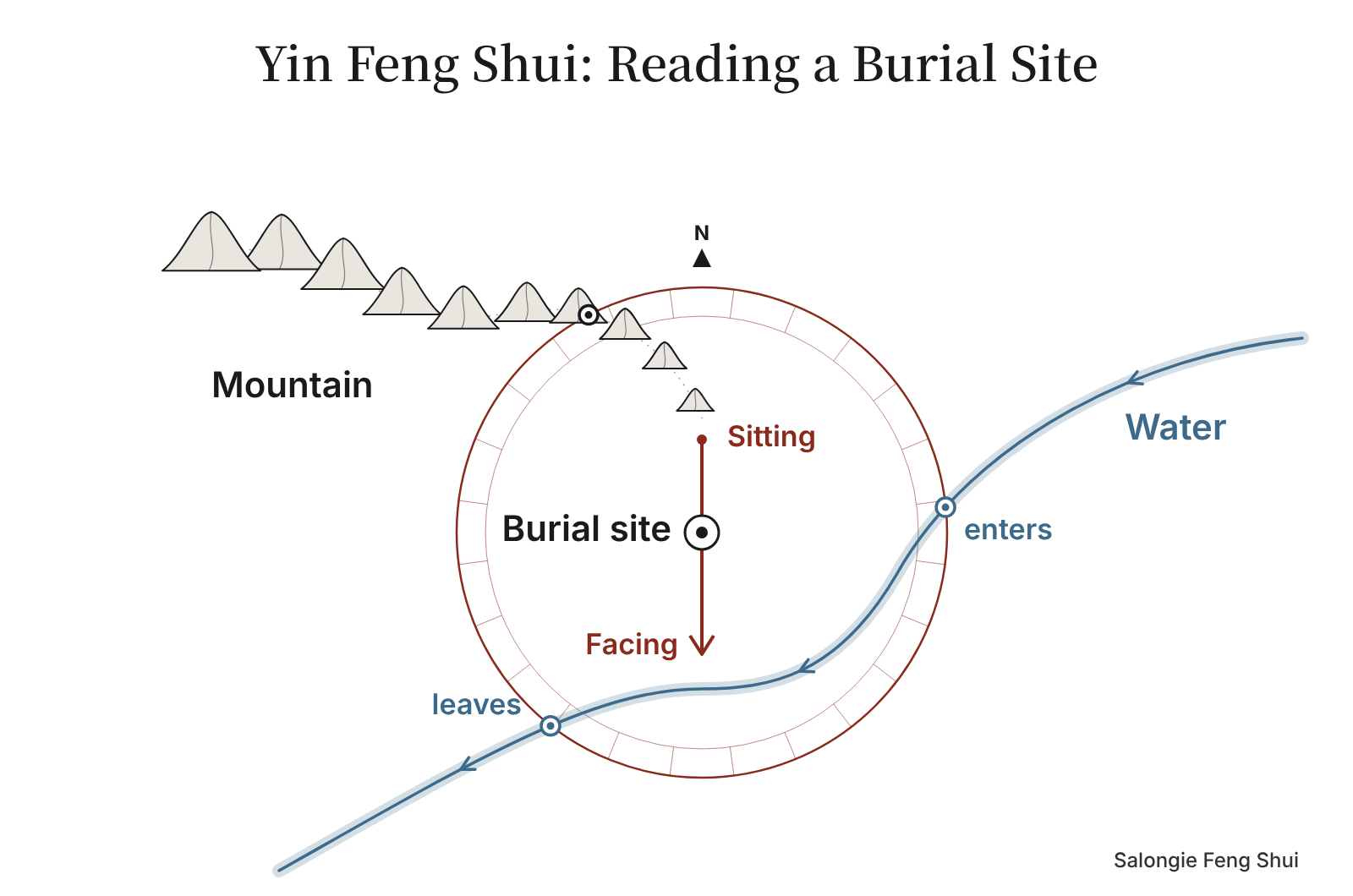
A Yinzhai, by contrast, is still: it is a person’s place of lasting rest. The question is how it is placed upon the land—what lies behind it, what it faces, and how it connects with the surrounding mountains and rivers. Its position and direction are understood through what Feng Shui calls its sitting and facing.
How Do Feng Shui Practitioners Find a Burial Site?
Imagine a practitioner in ancient China arriving in a mountainous region to find a burial place for a family. He first climbs to higher ground and looks out across the mountains and rivers. He observes where the mountain ranges come from, where they extend, and where they turn, rise, and fall. He also looks at how the rivers on either side of the mountains flow and where they meet.
In Feng Shui, a mountain range is likened to a “dragon.” A mountain range divides into progressively smaller branches, much as a tree grows from its roots into a trunk and then spreads into branches and leaves. He follows the course of the mountains, observing where they extend from and where they come to rest. Traditional Feng Shui understands the course of a mountain range as reflecting the course of the earth’s qi. If the mountains are the earth’s branches and leaves, then he is looking for its fruit: the place where the family can lay a loved one to rest.
In searching for a good burial place, he pays attention not only to the mountains but also to the rivers. Where does the water come from? Where does it go? Where does it turn or meet other water? These are all part of the observation. Mountains and water are not read separately. The course of the mountains, the movement of the water, and the relationship between them together shape how a place is understood.
When the practitioner finds a place worth examining more closely, he looks at what supports it from behind, whether the hills on either side protect it, and how the space and water in front are arranged. From these observations and his experience, he judges the precise place for burial. This is called dian xue (點穴), identifying the burial point. In traditional Feng Shui, that point is not an isolated patch of ground; it is connected to the forms of the entire surrounding landscape.
Identifying a burial point is a task approached with great care. In ancient times, when travel was difficult, some practitioners stayed in an area for months or even years, carefully observing its mountains, rivers, terrain, and other features. Accounts of this kind appear throughout classical Feng Shui writings. Some members of royalty, the nobility, and wealthy families also asked practitioners to find their future burial places while they were still alive.
The Feng Shui Compass and San He: Mountains, Water, and Orientation
The luopan (羅盤), or Feng Shui compass, is one of our most important tools. We use it to determine sitting and facing and to judge whether the conditions are favorable or unfavorable. The luopan divides a circle into twenty-four directions, known as the “twenty-four mountains.” In Yin Feng Shui, we begin by measuring the direction in which the mountain lies relative to the proposed burial site. For example, due east is called Mao (卯) on the compass. We would speak of “Mao Mountain,” rather than “the mountain at 90 degrees.”
We then use the luopan to measure the direction from which the stream enters the area and the direction in which it leaves. These directions are also described using the compass’s “mountains.” In this way, we establish the directions of both the mountain and the water.
Once we have these measurements, we can determine the grave’s sitting and facing. The choice depends on the particular relationship between the mountain and the water at that place. This is the basic logic on which Yin Feng Shui theory rests.
Different schools of Feng Shui apply their methods differently, but they all work within theories such as those of the Book of Changes (I Ching, 易經), Yin and Yang, and the Five Phases (五行, Wu Xing, often translated as the Five Elements). One of the most widely used approaches to Yin Feng Shui is San He (三合), a tradition that carries forward the core ideas of the Book of Burial. In Chinese, “San He” conveys the joining of three conditions. In burial-site Feng Shui, it can be understood through the particular relationship among mountain, water, and sitting and facing. Traditional Feng Shui holds that through a suitable sitting and facing, the deceased can receive the protection and comfort of the land, its mountains, and its rivers.
Why Burial Sites Matter: Ancestors and Cultural Meaning
To understand the importance of Yin Feng Shui in Chinese society, we must first understand how Chinese culture regards ancestors. Burial is not simply a matter of dealing with the body. It is a way of remembering one’s ancestors, and it is connected to family memory and continuity. A burial place is therefore not only a person’s resting place; it is also a place that connects a family with its ancestors.
In traditional thought, a continuing relationship exists between ancestors and their descendants: when the ancestors are at peace, their descendants are also understood to receive their blessings. This is part of the cultural background to the importance Chinese communities place on the burial of their ancestors. Thinkers through the ages have used the idea of resonance in qi to explain this relationship. Zhu Xi (朱熹, 1130–1200 CE), a Confucian scholar of the Song dynasty (960–1279 CE), for example, explained the importance of the burial place through the idea that ancestors and descendants share the same qi and respond to one another through it.
In Chinese tradition, Yin Feng Shui has never been merely a question of whether something is superstition. It has been a family matter taken seriously. To understand it, we must first see how this culture understands the relationship between people, their ancestors, and the land. Understanding its cultural meaning and asking whether its effects have been scientifically established are two different questions.
Without understanding Yin Feng Shui, it is difficult to see the full picture of Feng Shui or to understand the distinctive relationship among Heaven, Earth, and humanity in Chinese thought. While alive, people dwell between Heaven and Earth. After death, they are still laid to rest between Heaven and Earth, and their relationship with their descendants continues. Yinzhai and Yangzhai express this same understanding in two different circumstances: one for the living, the other for the dead.