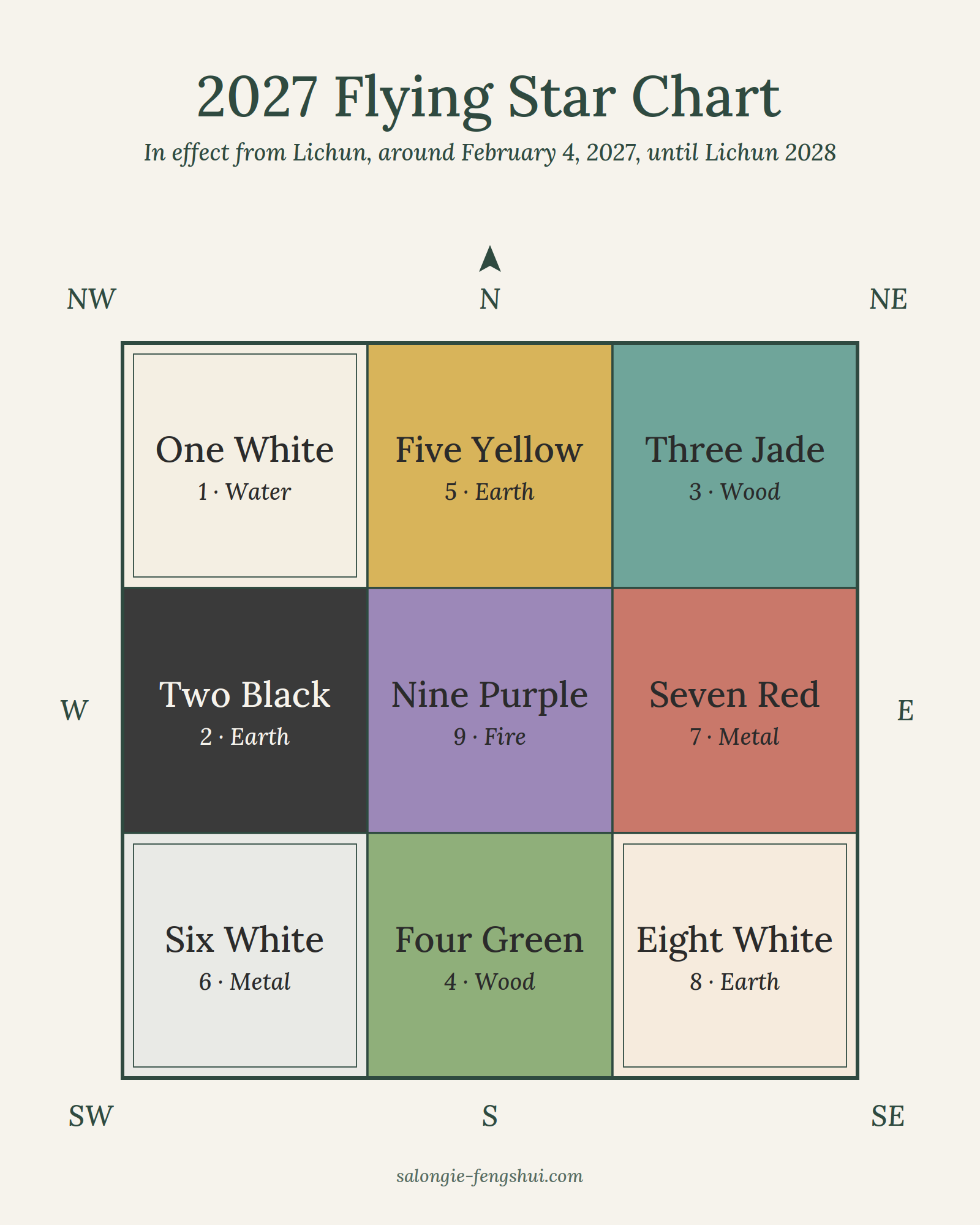
Flying Star Feng Shui is a traditional method that brings the passing of time into the way we read the areas of a home. The idea is that the different areas of the same home meet different flying stars from year to year, so the places that deserve attention can change as well. People consult the nine-star chart to understand the character of each area of a home in a given year, and to see what adjustments are possible.
This guide starts with the 2027 Flying Star chart and explains the date from which it applies. It then shows how to lay a nine-square grid over the floor plan of your own home, and goes through the nine areas one by one, with their meanings and common adjustments. What follows is an interpretation based on traditional Flying Star Feng Shui. It is not a personal prediction for anyone or any home.
In this guide
- The 2027 Flying Star Chart
- When Does the 2027 Chart Begin?
- Finding the Nine Areas in Your Home
- The Nine Areas in 2027
- Start with the Spaces That Matter Most to You
- Adjustments and Timing
- Where Flying Stars Fit in Traditional Feng Shui
- Related Reading
The 2027 Flying Star Chart
In 2027, Nine Purple enters the center. One White through Eight White then follow the flying sequence and land in the northwest, west, northeast, south, north, southwest, east, and southeast. This order does not go around the map in a circle; it is the stars’ own pattern. For now, we only need to know where each star is this year. We do not need to learn the whole calculation method. The table below lists the star in each area for 2027, along with the star’s phase in the Five Phases (五行, Wu Xing, often translated as the Five Elements). The chart itself is at the top of the page.
| Area | Star | Phase of the star |
|---|---|---|
| Center | Nine Purple | Fire |
| Northwest | One White | Water |
| West | Two Black | Earth |
| Northeast | Three Jade | Wood |
| South | Four Green | Wood |
| North | Five Yellow | Earth |
| Southwest | Six White | Metal |
| East | Seven Red | Metal |
| Southeast | Eight White | Earth |
When Does the 2027 Chart Begin?
Like the Chinese zodiac and the year names of the Heavenly Stems and Earthly Branches (干支), the Flying Star year does not begin on January 1. It begins at Lichun (立春), the Beginning of Spring, one of the twenty-four solar terms, which falls around February 4. So the 2027 chart takes effect at Lichun in 2027. It is not January 1, and it is not the first day of the Lunar New Year. Until Lichun, the 2026 chart is still in use, and the 2027 chart stays in use until Lichun in 2028.
If you have ever looked up your zodiac sign, you may know this principle already: someone born before Lichun belongs to the zodiac sign of the previous year. The Flying Star year turns at the same point.
Finding the Nine Areas in Your Home
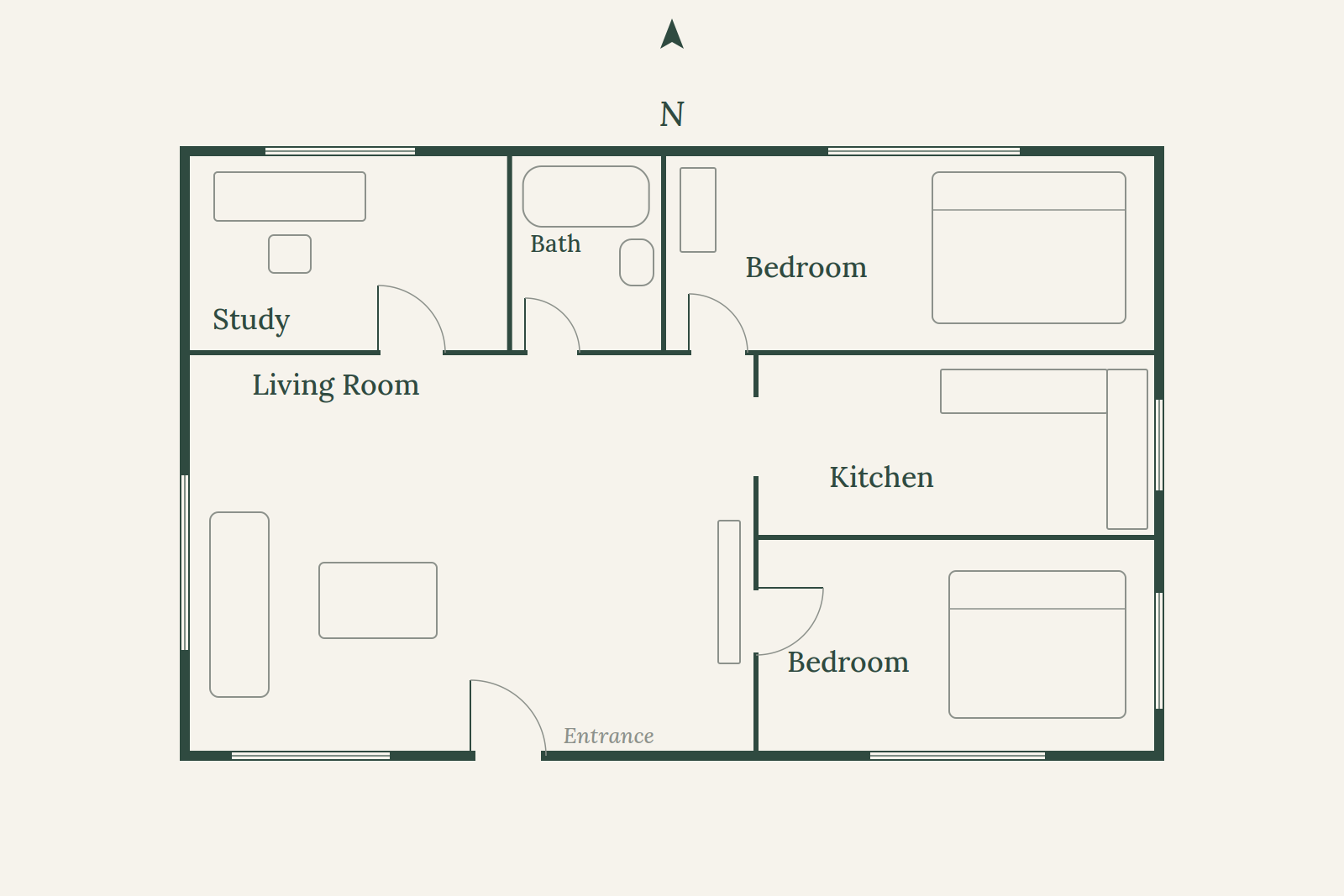
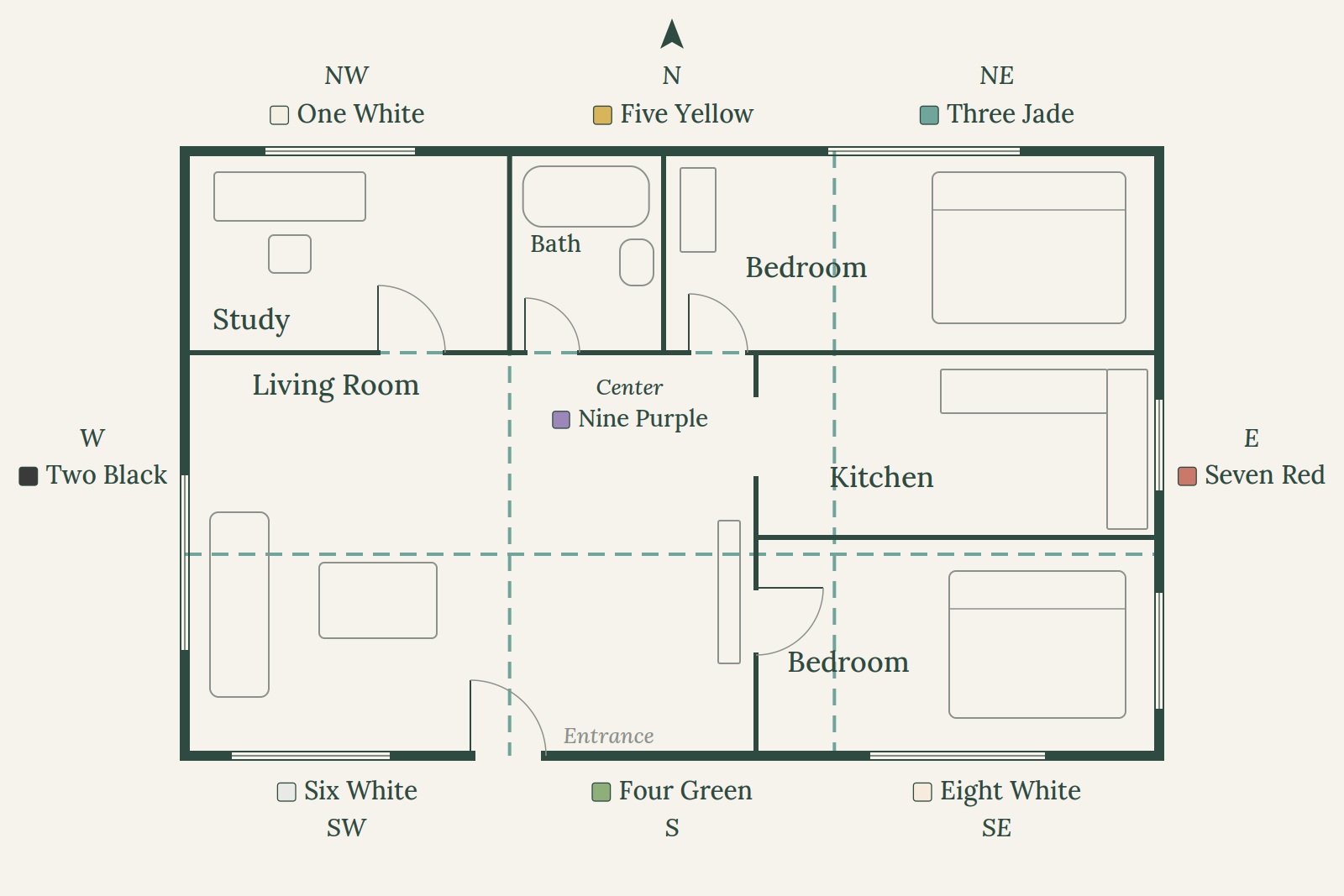
To use the chart in your own home, take a floor plan and lay an equal nine-square grid over it. First find the center of the home, then confirm the real directions of east, west, south, and north, for example with a luopan (羅盤), the Feng Shui compass. In our illustrations we use the familiar map convention, with north at the top and south at the bottom, but the top of a drawing is not necessarily the home’s actual north, so the real directions have to be confirmed before the grid can be lined up. Then you can see which area is Five Yellow in the north, which is Two Black in the west, and whether a study or desk falls in the northwest, where One White is.
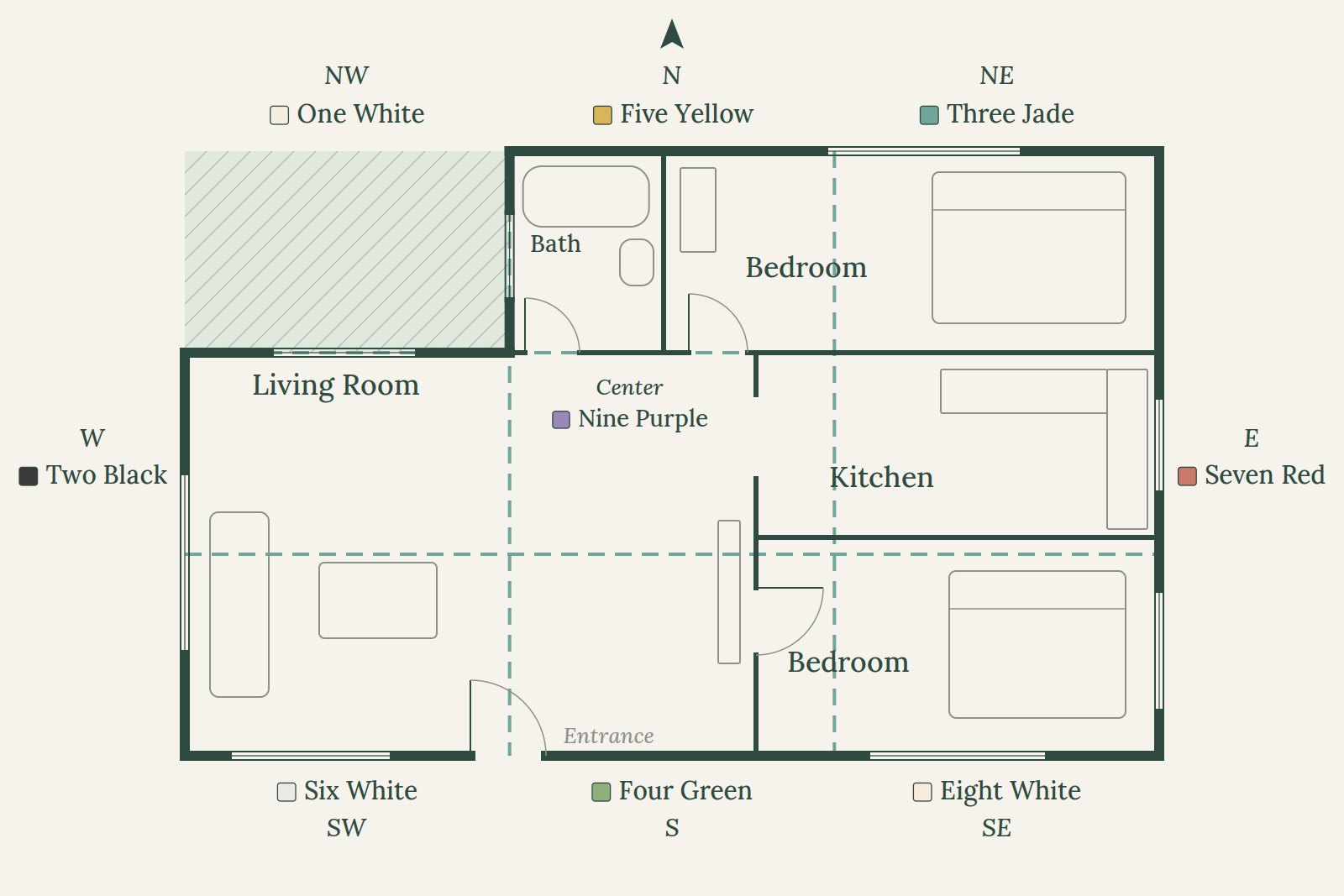
Some homes need a closer look. If a house is missing a corner, say the northwest, One White still lands in the northwest on the annual chart, but the house has no corresponding space there, so its significance in that home is usually less noticeable. And if a home has a very irregular outline, or a room stretches across more than one area, the reading takes more care, and a simple grid is not enough to draw conclusions.
The Nine Areas in 2027
Below we go through the nine areas in order, from One White to Nine Purple, with the meaning and common adjustments for each, so you can check them against your own home. Each area begins with what the star means in Feng Shui; if that area happens to be a space you use often, we then look at how to read it.
One White in the Northwest
One White in the northwest is an example that connects easily to daily life. If your study, desk, or usual reading spot is in the northwest, the meaning of One White is well worth considering. One White belongs to Water and the northwest belongs to Metal. Metal generates Water, so this is a strong combination in the Five Phases. In Feng Shui, One White is associated with wisdom, thinking, and social connections. For people who read, write, create, or work from home, the northwest is an area that sits close to how they actually use their space.
Two Black in the West
Two Black is associated in Feng Shui with illness and unfavorable conditions for health. This is the traditional meaning of the star. In practice, we also need to see what space the west corresponds to in your home. If a bedroom, the living room, or a room where an older family member often stays is in the west, you may want to look at how that space is used and arranged. Two Black belongs to Earth and the west belongs to Metal. Earth generates Metal, so there is already a natural give-and-take between them: in generating Metal, Earth gives up some of its own strength. You can also place an auspicious ornament or lucky charm that you like; there is no need to buy expensive Feng Shui products. Objects with religious meaning are fine too, because Feng Shui is not a religion and does not conflict with anyone’s faith. As a Feng Shui adjustment, you could also place a small plant grown in water in this area this year. Traditionally, this is thought to slightly reduce the influence of Two Black. It is a Feng Shui suggestion, not medical advice.
Three Jade in the Northeast
Three Jade belongs to Wood. In Feng Shui it is associated with arguments, quarrels, and disputes, and it is a star that needs attention. This year Three Jade lands in the northeast, and in the Chinese calendar of the Heavenly Stems and Earthly Branches the northeast also happens to be an area that calls for caution this year. The two overlap, which makes extra care worthwhile. In a situation like this, Feng Shui’s response is to be conservative and careful. If the living room or a bedroom is in the northeast, family members should communicate more calmly and rationally. But if that spot is only an unused corner, a storeroom, or even a missing corner of the house, it deserves no special attention, and there is no need to do anything special there.
Four Green in the South
Four Green belongs to Wood. It is known as the Wen Chang star (文昌星), the star of learning and literary success, and it is associated with study, reading, writing, creative work, and examinations. It is one of the favorable stars. To strengthen this scholarly quality, people keep the area tidy and quiet and place a desk, books, or green plants there. The area where Four Green sits is a good area in Feng Shui. In terms of how the space works, a study there would suit better than a bedroom. But the Flying Stars change every year, and it is neither possible nor necessary to change the layout of a home each year because of them. If you can, set aside a small space in this area as a corner for reading or thinking; it is also a simple way to experience the qualities of Four Green.
Five Yellow in the North
Five Yellow belongs to Earth. In Feng Shui it is associated with misfortune and calamity, and tradition counts it among the annual stars that call for the most caution. In 2027, Five Yellow is in the north. If your bedroom, study, or main entrance is in the north, the advice is not to break ground or undertake large-scale renovations in the north this year without good reason. That includes work inside the home, such as removing walls or drilling, and larger construction projects in a garden on the north side of the house. There is also an adjustment based on the Five Phases: Earth generates Metal, so metal objects are used to draw off and weaken Earth’s strength. This does not mean you should close off the rooms on the north side. The point is simply to avoid big, unnecessary construction and disturbance. If work does have to be done, make sure to follow the relevant safety regulations.
Six White in the Southwest
Six White belongs to Metal. In Feng Shui it is associated with authority, status, career advancement, and help from benefactors, and it is one of the favorable stars. The main thing is to keep the area clean and bright; there is also a practice of using metal, white, or gold furnishings to support Metal. The area of Six White suits any use of space. This year Six White comes to the southwest, so its good associations will be more noticeable. You might open the windows in the southwest to let in sunlight and fresh air. If there is a good view outside, that is better than any lucky object you could put there.
Seven Red in the East
Seven Red belongs to Metal. In Feng Shui it is associated with quarrels and financial loss, and it calls for attention. A common adjustment is, when Metal is too strong, to draw it off with Water, for example a bowl of clean water or a blue-and-black color scheme. Seven Red is not a favorable star, and this year, with Seven Red in the east, Metal controls Wood, which makes it easier to stir up its unfavorable qualities. If this area of your home is a workshop where you operate machinery or tools, the Feng Shui advice is to be more focused while you work and to follow safety regulations carefully.
Eight White in the Southeast
Eight White is linked with wealth and the building up of resources, and it is still a favorable star by nature. But we are now in Period Nine (九運), the twenty-year Period that began in 2024, so Eight White is no longer the ruling star of the period. The southeast belongs to Wood, Eight White belongs to Earth, and in the Five Phases Wood controls Earth. So although Eight White keeps its original auspicious meaning, its overall performance in the southeast this year is likely to be fairly unremarkable. It is not a good idea to treat the southeast as the strongest wealth area of 2027.
Nine Purple in the Center
This year Nine Purple enters the center and becomes the central star of the chart. It is also the ruling star of Period Nine. Nine Purple carries auspicious meanings of celebration, beauty, and liveliness. But Nine Purple belongs to Fire, and Fire has a restless, rash side as well as brightness and warmth. So even though Nine Purple is a favorable star, it is worth keeping its other side in mind. Livelier is not always better. If the center of your home is part of the living room, a place where the family spends time, or a passage you walk through every day, you can look at the light, the level of activity, and how easily people can move through the space. You don’t need to decorate the center of the home in bright red, or fill it with ornaments, just to strengthen Nine Purple. Arranging the space to suit what it is actually used for is the more practical approach.
Start with the Spaces That Matter Most to You
Here is one more practical idea for using the annual Flying Stars. You don’t need to rearrange all nine areas of your home every time a new annual chart comes out. A better approach is to begin by asking yourself: Which space do I use most, and which one matters most to me?
If you work from home every day, your study or desk naturally matters more. If your family spends a lot of time together in the living room, start there. If sleep and rest are your main concern lately, begin with the bedroom. Once you have found those places, check which star is visiting each one this year, and the annual chart connects with what you actually need in daily life.
This is also a different way to look at the annual stars: not changing your space for the sake of the stars, but understanding what the stars have to do, in Feng Shui, with the uses of your home that matter most to you. For example, if your study happens to be in the northwest this year, the meaning of One White fits how you use it closely. If your bedroom is in the west, you can look more closely at how the space is used and arranged, instead of rushing to move furniture. If your bedroom is in the north, this year you can simply avoid big, unnecessary construction. The annual Flying Stars are only one part of a Feng Shui reading, the part that changes with time. The home’s own layout, its surroundings, and the way each room is used still need to be read together.
Adjustments and Timing
Before looking at adjustments, it helps to have a basic attitude: doing nothing is a reasonable choice. Sometimes, awareness of the space itself is a more important way of responding.
Traditional adjustments fall roughly into three kinds. The first is avoiding disturbance, for example avoiding unnecessary digging and large construction in the area of Five Yellow. The second is adjusting according to the generating and controlling relationships of the Five Phases, for example drawing off Earth with Metal, or drawing off Metal with Water. Color and material are among the ways the Five Phases are expressed and adjusted, but the premise is to first understand the relationship between the star and the area, and only then decide whether to adjust at all. The third is placing auspicious ornaments. You can choose ones you like; they don’t have to be expensive, and objects with religious meaning are fine too.
As for timing, the Flying Stars take effect at Lichun. If an area genuinely needs digging or larger construction, the usual advice is to finish it before Lichun. For example, in 2027 Five Yellow is in the north. If work on the north side of your home is truly necessary, you could complete it in December 2026, so that when the new year begins you don’t need to disturb the north again.
Necessary repairs and safety always come before any Feng Shui advice.
Where Flying Stars Fit in Traditional Feng Shui
Within Feng Shui as a whole, Flying Star Feng Shui belongs to Li Qi (理氣), the part of Feng Shui concerned with orientation and timing, and it is the method that deals specifically with time. The annual Flying Stars change every year, so the same area meets a different star in different years. They do not replace the reading of the surroundings, the form of the building, the layout, and the use of the space.
A few words on where Flying Star Feng Shui comes from. The framework of nine areas is very old. The practice of naming the nine stars with a number and a color was in use by the Tang dynasty (618–907 CE) at the latest, and calendar fragments excavated at Dunhuang (敦煲) show it.
In my own study of Feng Shui over more than forty years, I have come to believe that Flying Star Feng Shui took its concrete form in the late Ming and early Qing (the 17th century), and quickly became one of the most widely followed schools of Li Qi, perhaps because its framework is clear and approachable. That said, the Flying Stars are one school within Li Qi, and Li Qi is one of the two main parts of Feng Shui. So my own approach is this: I find the Flying Stars well worth consulting, but I don’t rely on them alone. I read them together with the surroundings, the layout, and the way the space is used.
Related Reading
That covers the 2027 Flying Star chart and its nine areas. The most worthwhile thing to do next is to go back to the spaces you use most, see which star has landed there this year, and then decide whether a small adjustment is worth making.
Related reading: