
How Does Traditional Feng Shui Assess a Site and Its Surroundings?
Beyond Admiring the Landscape
An old saying from the Analects observes that “the wise delight in water, while the humane delight in mountains.” Its philosophical meaning belongs to another discussion, but the image of mountains and water offers an appropriate place to begin.
Before we approach a building, the eye first meets the larger forms around it: rising and descending land, open ground, water, and the routes by which the place is reached. A house may appear to be the obvious subject, yet it already occupies one position within a much wider setting.
In Traditional Feng Shui, mountains and water are not examined only as scenery. Their form, position, scale, and movement help establish the conditions through which Qi approaches, gathers, settles, or disperses. A building cannot be separated from these conditions simply because walls have been placed around it.
Feng Shui assessment therefore begins by widening the field of observation. Before asking what happens inside a building, it first asks what kind of environment the building belongs to and how that environment has formed the site on which it stands.
How a Landscape Forms a Setting
Seen from farther away, a landscape may first appear as a broad arrangement of higher and lower ground, slopes, openings, and water. As we look more closely, these forms begin to reveal how a place is structured.
Rising ground may shelter an area or give definition to the wider setting. A slope may direct approach, water, and movement toward lower ground. Openings between surrounding forms may connect one part of the landscape to another, while enclosed areas may slow and contain what reaches them.
In Feng Shui, these observations matter because environmental form influences the conditions under which Qi moves through a place. Terrain may allow Qi to approach and settle, guide it through an area, carry it away, or expose a location to movement that is too direct or forceful.
The effect of higher ground cannot be understood from height alone. At an appropriate distance, it may shelter and define the setting. When steep or disproportionately close, it may restrict approach and place sustained pressure upon the area below. A broad opening may create access and release, but without enough surrounding definition it may also allow movement to disperse before it can gather.
Water makes these relationships especially visible. A river may curve through the terrain, a stream may descend along a slope, or a lake may occupy a contained area of lower ground. Feng Shui examines how the water approaches, where it turns, how quickly it moves, whether it passes or settles, and how its scale relates to the surrounding land.
Water is important not merely because it is present. It reveals and influences patterns of movement, gathering, and dispersal associated with Qi. Water that curves or slows within a well-formed setting may help establish conditions in which Qi can settle. Water that moves too rapidly or too directly may carry those conditions past an area before they can be retained.
Stillness alone is not a negative quality. Calm or contained water may remain vital when it is clean, renewed, and appropriately related to its setting. Stagnant or deteriorating water is different. Water that is polluted, foul, decaying, or deprived of renewal indicates decline rather than stable gathering and is generally regarded as unfavorable to the surrounding site.
Landform and water are therefore read together. They establish boundaries, routes of approach, areas of shelter, and patterns through which Qi is directed or dispersed. Yet the wider landscape alone does not tell us the condition of a particular site. To understand that, we must move closer and ask where the site stands within these larger relationships.
Finding the Site Within the Landscape
As attention narrows, the question changes. We are no longer looking only at the landscape as a whole. We begin to ask where the site sits within it.
A site beneath rising ground, beside a slope, near a widening of the terrain, or at the mouth of an opening will not receive the same conditions. Its position affects how movement approaches, whether surrounding forms provide shelter, and whether Qi can gather without becoming blocked or dispersed.
Containment is an important part of this assessment. It does not mean that a site should be enclosed on every side. The surrounding environment should provide enough definition to shelter and retain Qi while still allowing renewal and movement.
Visible enclosure may contribute to containment, but enclosure that is too close, high, or complete can produce compression rather than support. In the same way, a slope or larger form may provide useful backing at one distance and become imposing at another. Support is not a permanent quality of an object. It is the result of a proportionate relationship between that form and the site.
Openness also changes according to scale. An open area may give approaching Qi room to slow, distribute, and gather before reaching the site more directly. If the opening is too broad or insufficiently defined, however, it may leave the site exposed and allow movement to pass through without settling.
Traditional Feng Shui describes an important receiving space of this kind as Ming Tang (明堂, traditionally “Bright Hall”). Ming Tang is the open spatial field associated with a site or building where approaching Qi can be received, moderated, and gathered.
A Ming Tang may be formed by open ground, a widening in the terrain, the relationship between land and water, or other surrounding forms that create space before the site. Its importance lies not simply in providing an open view, but in establishing a transition between the wider environment and the building.
A larger Ming Tang is not automatically more favorable. Its scale must be proportionate to the site, and its openness must be sufficiently defined to receive Qi without becoming exposed. A broad but uncontained space may encourage dispersal, while a more modest but clearly formed Ming Tang may provide a stronger field of reception and gathering.
At this stage, Feng Shui assessment begins to move from observation toward judgment. A hill, body of water, or opening does not carry a fixed meaning on its own. Its significance emerges from its position, distance, scale, and effect upon the particular site.
In a city, the visible forms change, but these questions remain.
When the Landscape Becomes Urban
As the view moves into an urban environment, ridges and waterways may recede from sight. Streets begin to carry movement across the ground, while rows of buildings define what is open, enclosed, sheltered, or pressed.
Roads are sometimes interpreted by analogy with water. The comparison concerns form and movement: how a road approaches, passes, curves, converges, or moves away from a site, and how its width, speed, distance, and alignment intensify or moderate those conditions. In urban Feng Shui, roads matter because they influence how movement and Qi approach, pass, concentrate, or disperse around a site.
A road passing beside or in front of a site may provide access and connection. When movement approaches gradually and the building has sufficient setback or a well-formed Ming Tang, the site may receive that activity without being overwhelmed by it. A wide or fast road placed too close to the building creates a different condition. Movement passes continually, leaving little opportunity for Qi to slow and settle around the site.
Curving roads also need to be read in relation to position. A bend may guide movement toward an area, carry it around the site, or turn away before a meaningful relationship is formed. On another part of the same curve, the direction of movement may place concentrated pressure upon the site. The curve itself is not the judgment; the question is how its form directs movement in relation to the site.
Intersections make these relationships more concentrated. Several roads meeting near a site may increase access, visibility, and activity. Such conditions may support certain commercial uses, while creating excessive exposure and disturbance for a residence that requires greater stability.
A T-junction provides a clear example of how road form becomes a Feng Shui condition. When a road terminates directly toward a site, movement is concentrated along a single axis rather than passing from the side. If the road is long, broad, fast, and closely aligned with the building or its entrance, the site may be subjected to direct exposure and repeated disturbance.
The condition becomes more severe where there is little setback, no effective Ming Tang, or no intervening form to slow the approach. In Feng Shui terms, the site has difficulty receiving and moderating the incoming movement before it reaches the building.
The name T-junction is only the beginning of the assessment. A narrow residential lane carrying slow movement does not impose the same condition as a major road directed toward the same position. Road width, speed, distance, changes in level, building alignment, and the space before the entrance all alter the consequence.
Where movement is strongly concentrated upon a building, the condition is generally unfavorable. Relational assessment explains why the influence is stronger in some settings and weaker in others.
Neighboring buildings also shape urban Feng Shui. Their height, mass, distance, and position may define open space, shelter a site, obstruct approach, or create sustained pressure. Their spatial effects can sometimes be compared with surrounding natural forms, although the comparison is functional rather than literal.
A proportionate building mass at a suitable distance may help contain and shelter a smaller site. A much larger structure placed too close may reduce openness, dominate the surrounding scale, or prevent Qi from approaching and circulating effectively. Gaps between buildings may create access and release, while a narrow opening between imposing masses may direct movement too sharply toward a smaller building.
Urban Feng Shui therefore observes more than traffic function or building density. It asks how roads and built forms organize the external Qi conditions of a site: whether they connect or bypass it, shelter or compress it, allow movement to gather, or direct it too forcefully toward the building.
The next question is no longer simply what surrounds the site, but how one particular building receives these conditions.
How the Building Receives Its Surroundings
At the scale of the individual building, position becomes more specific. Setback, entrance, form, and orientation determine which parts of the surrounding environment the building faces and how those conditions reach it.
The entrance is one of the principal points through which a building begins to receive the Qi conditions formed across the site. It connects the building to roads, open space, the Ming Tang, and the approach created by surrounding forms.
An entrance reached gradually across a proportionate setback may receive movement in a moderated way. An entrance placed directly on a road axis may encounter the same movement before it has had space to slow, turn, or distribute. The entrance does not create the external condition, but it affects how directly the building receives it.
The Ming Tang must therefore be understood in relation to the building it serves. An open area may appear adequate at the scale of the site yet fail to form an effective receiving field if the entrance is poorly positioned or remains directly exposed. A smaller but more clearly defined Ming Tang may perform its function more effectively because its scale and approach are better related to the building.
Orientation further changes this relationship. The same road may lie before one building and beside another. A neighboring structure may shelter one side of a building while obstructing another. An opening between buildings may provide access for one entrance but direct movement too sharply toward a differently oriented building nearby.
Orientation here refers to the fundamental question of which environmental conditions the building faces, receives, or turns away from. A complete compass or time-based analysis belongs to a later stage of assessment.
Consider two buildings on the same street. One is set back far enough for movement from the road to pass through a defined open space before reaching its entrance. The other stands closer to the road and nearer the axis of an approaching street. Although both belong to the same district, they do not receive the street in the same way.
The first building has more opportunity to moderate the movement that reaches it. The second is more directly exposed to concentrated approach. The difference does not arise from the road alone, but from the relationship among road form, setback, Ming Tang, entrance, and orientation.
This is why surroundings do not act upon a building in the abstract. Feng Shui moves from the wider environment to the site and then to the particular way a building receives what surrounds it.
From Observation to Judgment
Observation becomes Feng Shui assessment when an environmental condition is interpreted according to what it enables or prevents.
A favorable site is one in which Qi can be received, sheltered, gathered, and renewed without becoming stagnant or overwhelmed. Movement can approach without striking the building too abruptly. Open space provides reception without excessive exposure. Surrounding forms offer definition and support without compression.
Unfavorable conditions interfere with these functions. Repeatedly concentrated movement may disturb the site. Excessive openness may prevent Qi from settling. Large or closely placed forms may impose pressure and restrict approach. Deteriorating water or neglected surroundings may introduce conditions of stagnation and decline.
These judgments concern the functioning of the site and building. They ask whether the external environment supports stable occupation, whether Qi can gather and circulate, and whether the building must continually resist disturbance, dispersal, or pressure.
The intended use of the building also matters. Visibility and concentrated activity may support a shop, restaurant, or public entrance. The same conditions may be disruptive for a residence that requires greater stability and privacy. A quiet and contained setting may support domestic life while providing insufficient presence for some commercial uses.
Personal experience may offer clues. A sense of pressure, exposure, ease, or protection can draw attention to something in the environment. Feng Shui then asks what produces that response: scale, distance, movement, obstruction, enclosure, or the directness of approach. Feeling can alert observation, but the judgment must return to the spatial conditions that consistently affect the site.
Traditional Feng Shui recognizes recurring favorable patterns, including well-formed Ming Tang spaces, proportionate surrounding support, and water that gathers without stagnating. Their value lies in the relationships they create rather than in isolated objects or formulas that can be transferred unchanged from one setting to another.
Assessment therefore proceeds from observable condition to Feng Shui interpretation and consequence. It asks what the environment allows the site to receive, what it helps the building sustain, and what pressures or limitations are already present before attention turns inward.
Before the Assessment Moves Inside
By the time we reach the entrance, the building is no longer an isolated object. The wider landscape or urban setting has already shaped the routes by which Qi approaches, the areas in which it may gather, and the forms that shelter, expose, or press upon the site.
Internal organization can influence how these conditions are received, directed, distributed, or intensified. It can help a building work more effectively within its setting, but it cannot erase the larger environment in which the building stands.
At the threshold, the direction of assessment changes. The question is no longer how the surrounding environment reaches the building, but what happens after those conditions enter: how the building’s internal organization receives, guides, gathers, or obstructs them.

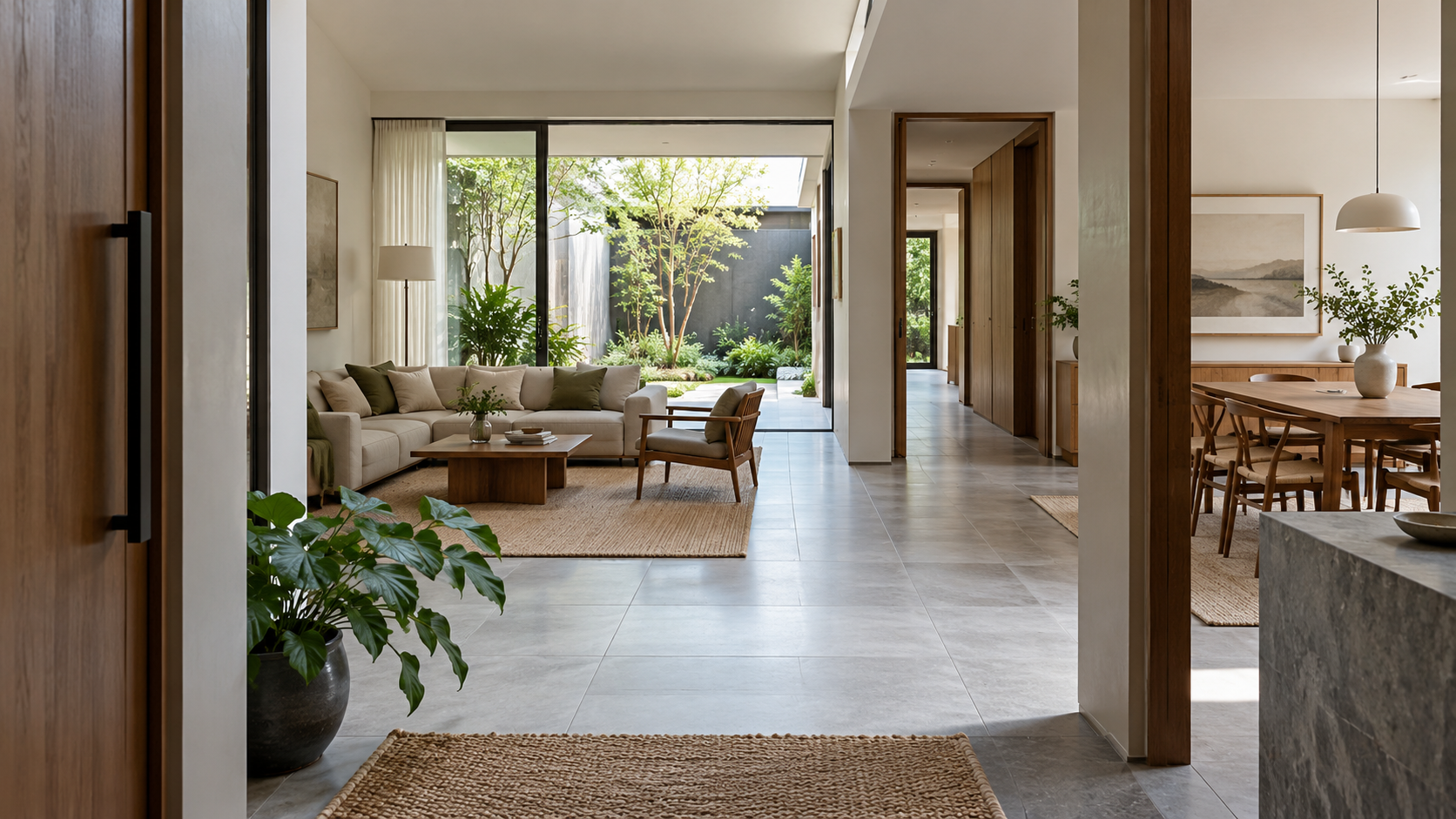
How Does the Internal Organization of a Building Contribute to Its Feng Shui Conditions?
From Site to Interior: What the Building Is Positioned to Receive
A building does not become separate from its surroundings once we step inside. Before its rooms, doors, or furnishings can be considered, it must first be understood in relation to the place it occupies. The land, nearby forms, roads, water, and surrounding buildings establish the wider setting. The building’s orientation determines which part of that setting it is positioned to face and receive.
In Traditional Feng Shui, establishing a building’s orientation is more than assigning it a compass direction. It relates the building to what lies around it. A house may stand in a favorable setting yet make limited use of it if its facing direction turns away from the more supportive features of the site.
This can be compared, in a limited sense, to tuning a radio. The surrounding signal may be present, but the receiver must be properly directed before the sound becomes clear. Feng Shui is not describing Qi as a physical broadcast; the analogy simply shows why direction matters.
What people consider a good view often provides an accessible starting point. A doorway or main room may open toward a calm garden, open water, distant hills, or an orderly urban outlook. Feng Shui asks a further question: what forms are present, how do they approach the building, and does the direction offer conditions the house can use?
A courtyard, forecourt, porch, or setback may help receive, protect, or collect what approaches the house before it reaches the interior. Such spaces are not requirements. A house without them can still be assessed through the relationship between its entrance, facing direction, the space before it, and the surrounding environment.
The first step in reading an interior is therefore not to begin with an isolated room. It is to ask what the building has been positioned to receive.
Qi Mouths: Doors, Windows, and Reception
Attention then turns to the openings through which the building receives Qi. In Traditional Feng Shui, an entrance or opening is a location; a Qi mouth (氣口) is a function. Doors, windows, and other significant openings may function as Qi mouths when they play an important role in how the building receives Qi from particular directions and external forms.
The main door is usually one of the most important of these openings. Its significance depends on where it is placed, what direction it faces, and what lies beyond it. A door opening toward a supportive setting does not create that setting; it allows the building to receive it. A door facing a pressured or disordered form may bring that relationship more directly into the house.
Windows also participate in reception, although they do not all carry the same weight. Their effect depends on position, direction, relative size, distance from important interior spaces, and the forms they face outside. A window overlooking an open and well-formed landscape is different from one pressed closely against another building, even if both admit the same amount of daylight.
Qi should not be imagined as air moving mechanically through a floor plan. Ventilation, human movement, and Qi involve different kinds of observation. Feng Shui considers orientation, direction, and the relationship between an opening and what it faces.
The alignment of a door with another door or window must therefore be read conditionally. A strong alignment may create penetration, exposure, or difficulty gathering, especially when openings are close, large, and directly opposed. Greater distance, an intervening room, a change in direction, or different external forms may alter the effect. Not every aligned opening produces the same result.
Doors and windows do more than puncture walls. They help determine how a building and its rooms remain connected to particular directions and external conditions.
Where the House Gathers: The Main Living Area
In many homes, the main living area becomes the principal gathering place within the interior. This is often the living room, not simply because of its name, but because it receives guests, supports family activity, and connects several parts of the house.
A dwelling usually needs a place where its shared life can settle. Without a recognizable center, the interior may remain fragmented even when its individual rooms are usable. The principal gathering space helps organize the relationship between entrance, common activity, and the rooms around it.
In one house, the entrance may lead toward a clearly formed room where seating, views, and adjoining spaces establish a stable center. In another, the area called the living room may sit at the edge of the plan, divided by competing uses or treated mainly as a route elsewhere. Similar furniture does not give the two rooms the same role.
A main living area that gathers well gives public activity somewhere to settle and allows the interior to organize itself around a shared center. From there, the relationships among entrance, adjoining rooms, and more private areas become easier to read.
The principal gathering space is not always the room labelled “living room.” What matters is which area actually receives and organizes the shared life of the house.
How Boundaries Form Feng Shui Spaces
A room becomes a Feng Shui space when a boundary establishes where one set of conditions ends and another begins.
Some boundaries are obvious: walls, doors, and enclosed rooms. Others are more subtle. A change in level, a partial partition, a turn in the plan, or the placement of substantial furniture may define one area from another. In each case, the boundary gives the space enough coherence to hold conditions of its own.
Without sufficient definition, an intended bedroom, study, or dining area may remain exposed to the activity, openings, and character of surrounding spaces. Its designated use cannot by itself create privacy, stability, or inwardness.
Boundaries do not require complete separation. A space also needs appropriate openings through which it receives Qi and remains connected to the rest of the building. Walls, partitions, doors, and windows therefore work together, defining an interior while regulating its relationship with adjoining rooms and particular directions.
A large open-plan interior makes this easy to see. Several functions may occupy the same continuous floor, yet not every group of furniture forms a distinct Feng Shui space. One area may have a clear edge, a recognizable center, and openings that relate to it. Another may sit between several routes and remain exposed on all sides.
Passages also shape these relationships. A doorway or corridor establishes an approach between spaces and affects how much one area is exposed to another. A quiet room opening directly onto a busy central area may struggle to maintain its own character. A room cut off too completely may lose a useful relationship with the larger interior and the Qi mouths from which it receives.
The question is not whether an interior should be open or closed. It is whether each space has enough definition to form conditions of its own while remaining appropriately connected to the building as a whole.
Yin–Yang and the Use of Interior Spaces
What makes a bedroom different from a living room in Feng Shui terms is not the label on the plan, but the qualities the space actually holds. Traditional Feng Shui uses Yin–Yang to compare these qualities: active and quiet, open and enclosed, bright and shaded, public and private.
The purpose is not to assign every room a fixed category. It is to ask whether the character of a space is appropriate for what takes place there.
A main living area usually benefits from relatively Yang conditions. It may be brighter, more open, more connected to the entrance, and better able to support conversation and shared activity. Yet it should still be able to gather. If it is exposed on all sides, divided by too many openings, or continually crossed by competing routes, its activity may become scattered rather than centered.
A bedroom tends toward relatively Yin conditions because rest requires greater quiet, inwardness, and stability. Clearer boundaries and less disturbance from adjoining spaces may support that use. Greater Yin, however, does not mean complete darkness or isolation. A room that is excessively closed or poorly connected may no longer support rest appropriately.
Changing the stated use of a room does not change its Feng Shui conditions. A bright, open room near the entrance does not become quiet and inward simply because it is renamed a bedroom. An enclosed room at the back of the house does not become suited to frequent social activity merely because it is furnished as a reception area. The underlying relationships remain until the boundaries, openings, or arrangement are materially changed.
Good internal organization does not require every room to contain equal amounts of Yin and Yang. Different parts of the building need qualities suited to their roles while remaining connected within the larger whole. Traditional Feng Shui may also consider whether certain Five-Phase qualities have become disproportionately prominent, but such judgments depend on the entire arrangement rather than fixed associations of colors, materials, or room types.
From Rooms to Important Positions
Even within a room that is generally suitable for its purpose, conditions are rarely identical from one point to another. Feng Shui therefore narrows its attention to the places where people remain for long periods or where the room’s main function occurs.
In a bedroom, that place is the bed. The room may be quiet and enclosed overall, yet the bed itself can still be exposed to a doorway, pressed between openings, or placed where the surrounding form offers little stability. Because sleep occupies many hours, the conditions at the bed matter more than those in a corner that is seldom used.
The same principle applies to a desk or main seat. Feng Shui observes what lies behind the position, what opens in front of it, and how doors, windows, and adjoining activity relate to it. A position with a stable background and suitable openness ahead may make better use of the room’s existing conditions. One exposed to several openings or placed directly within a strong route of approach may be more easily disturbed.
In a kitchen, the stove carries particular weight because the room’s central function is concentrated there. Its significance comes from the way this position relates to the kitchen, nearby openings, and the organization of the house. It is not judged apart from the room that contains it.
Furniture becomes relevant when it materially changes these spatial relationships. A large cabinet may create a practical boundary. A screen may divide one area from another. A sofa arrangement may help establish the center of the main living area, while moving a bed or desk may place a person within a different set of conditions.
Replacing a chair, changing a color, or adding a small object may leave the underlying configuration untouched. Furniture matters when it changes how a space is formed, where an important position lies, or how that position relates to boundaries and Qi mouths.
This closer scale of observation asks where the life of each room actually takes place and whether those positions can use the more supportive conditions available within the interior.
Reading the Interior as a Connected Whole
An interior cannot be understood by isolating a single door, room, or object. Each feature takes on meaning through its relationship with the rest of the building.
A bedroom may hold suitable Yin conditions overall, yet the bed may occupy an exposed position. A living room may appear open and inviting but fail to act as the center of the home because its connections scatter activity rather than gather it. These differences only become visible when the interior is read as a whole.
Human experience can help reveal such conditions. A room that is rarely used, a seat that is difficult to remain in, or a sleeping area that is continually disturbed may indicate that the internal organization is not supporting its intended use. These experiences are useful clues, but they are not conclusions by themselves. Assessment must return to the spatial relationships that produce them.
Meaningful adjustment begins only after those relationships have been accurately interpreted. The task is not merely to identify one visible problem, but to understand how orientation, Qi mouths, boundaries, uses, and important positions combine within the whole interior. Without that understanding, a change may address a symptom while leaving the underlying Feng Shui condition untouched.
The internal organization of a building contributes to Feng Shui by shaping how the building receives, gathers, differentiates, and uses the conditions available to it. Learning to read these relationships is the first step toward understanding the Feng Shui of the interior.