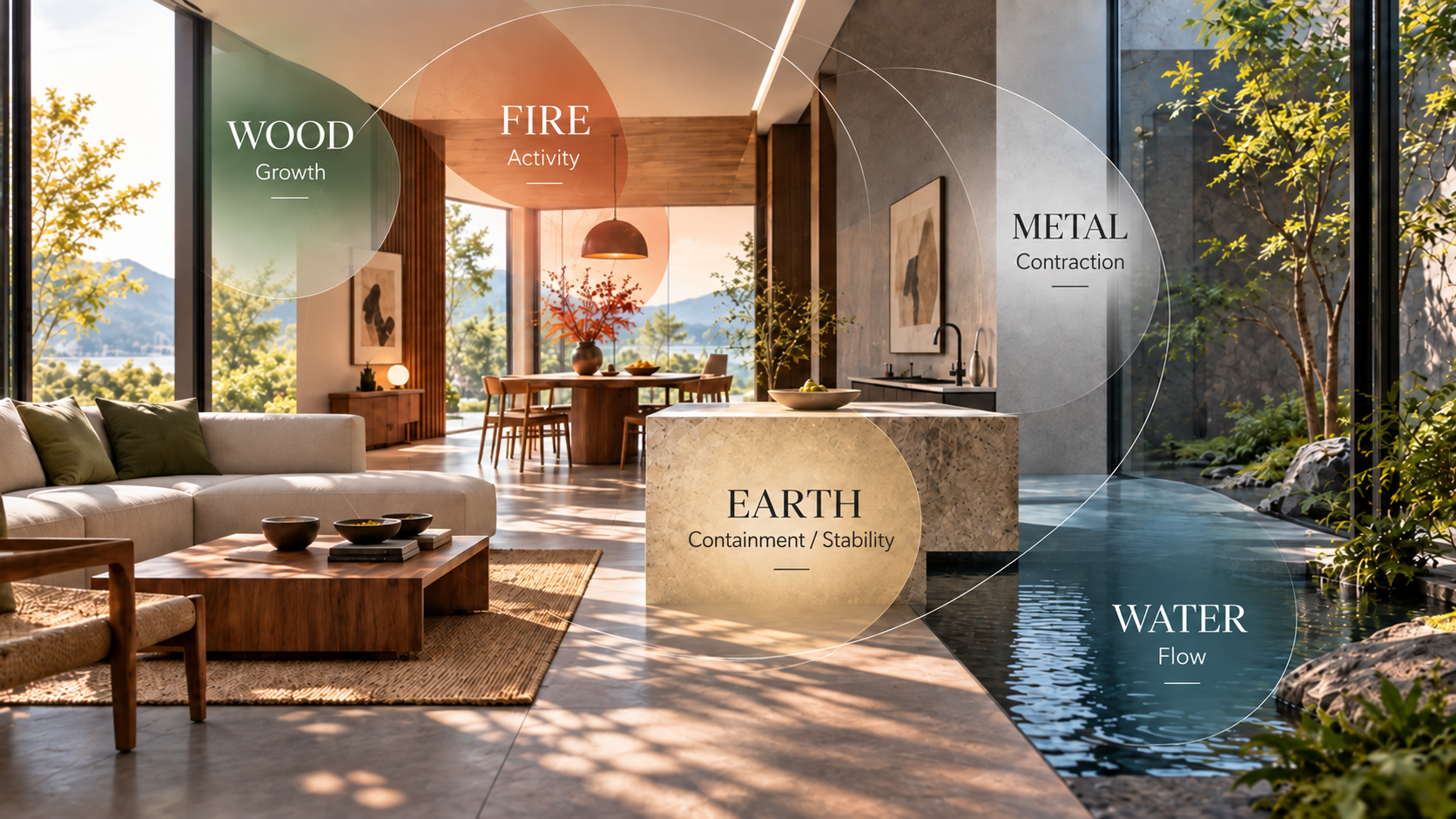
What Are the Five Phases in Traditional Feng Shui?
Why Are They Called the Five Phases?
Wood, Fire, Earth, Metal, and Water are widely known in English as the Five Elements. This familiar term reflects the fact that the system takes its names and basic images from five recognizable materials.
Yet the word element can also suggest a fixed substance—one of a small number of materials from which everything else is made. This does not fully express how Wood, Fire, Earth, Metal, and Water are understood in Traditional Feng Shui. Their physical qualities provide the starting point, but the system is not limited to the materials themselves.
The term Five Phases (Five Elements) retains the familiar English name while better expressing a system understood through activity, relationships, and change.
From Familiar Materials to Wider Patterns
The names Wood, Fire, Earth, Metal, and Water are not arbitrary symbols. Each begins with qualities that can be observed directly. Wood grows and extends. Fire rises, gives off heat and light, and spreads. Earth supports and contains. Metal is hard, sharp, and contracting. Water moves downward and follows available paths.
In the Five Phases, these familiar qualities extend beyond the materials themselves. They become a way of recognizing recurring tendencies such as growth, expansion, stability, contraction, and flow, together with the relationships and changes that arise among them.
Analogy allows different phenomena to be connected through shared qualities. These correspondences are based on established characteristics and relationships rather than superficial resemblance alone.
How the Five Phases Relate to Qi and Yin–Yang
In Traditional Feng Shui, Qi, Yin–Yang, and the Five Phases offer related ways of understanding a place.
Qi helps Feng Shui recognize what is active within a place—how influences move, gather, disperse, and interact. Yin–Yang distinguishes broad relative qualities within this activity, such as active and quiet, or bright and dark.
The Five Phases provide a more differentiated language. They distinguish more specific tendencies and describe how these tendencies support, regulate, and respond to one another. They do not divide Qi into five separate kinds of energy, nor do they replace Yin–Yang.
Together, these concepts allow Traditional Feng Shui first to recognize the activity present in a place, then to distinguish its broad relative qualities, and finally to understand its more specific characteristics and relationships.
The Character of Wood, Fire, Earth, Metal, and Water
Each phase takes its basic character from the observable qualities of its corresponding material.
Wood is associated with growth, extension, and development. A plant rises from the ground, bends around obstacles, and spreads outward as it develops. Wood therefore includes both rising and curving movement.
Fire is associated with heat, light, upward movement, and rapid activity. A flame rises, spreads when conditions allow, and can change its surroundings quickly.
Earth receives, contains, and provides stability. It provides a stable basis that can hold and sustain what rests within it. Earth is closely associated with steadiness, containment, and the capacity to support what is present.
Metal is associated with hardness, sharpness, coldness, and contraction. Its sharpness allows it to cut and separate, while its cold quality is associated with drawing inward. These qualities give Metal a clear and decisive character.
Water moves downward and follows the paths available to it. It flows around obstacles, penetrates openings, and adapts to the terrain it crosses or the container that holds it. Water is therefore associated with flow, flexibility, penetration, and adaptation.
The character of each phase becomes clearer through its relationships with the others—through the ways they support, restrain, and respond to one another.
How the Five Phases Generate and Control One Another
Two of the most important relationships among the Five Phases are the generating cycle and the controlling cycle.
In the generating cycle, Wood generates Fire, Fire generates Earth, Earth generates Metal, Metal generates Water, and Water generates Wood. This sequence describes how one phase produces, supports, or provides conditions for another. Wood can feed Fire, and Water allows Wood to grow. Each link expresses support in a different way, and together they form the traditional generating sequence.
The generating relationship is not automatically favorable. Support may strengthen a phase that is already excessive, while too little support may leave another unable to develop. Its meaning depends on the condition being considered and on the wider relationship among the phases.
The controlling cycle follows a different sequence: Wood controls Earth, Earth controls Water, Water controls Fire, Fire controls Metal, and Metal controls Wood. Here, control does not simply mean destruction. It describes restraint, regulation, and the prevention of unlimited development. Water can restrain Fire, Metal can cut Wood, and Earth can contain or direct Water.
Control is therefore not automatically unfavorable. Without restraint, one tendency may grow beyond an appropriate degree or overwhelm the others. Generation allows activity to continue and develop; control places limits on that development and helps regulate its strength.
Balance depends on the relationships among the phases, not on making them equal. A strong expression of one phase may be suitable in one situation and excessive in another. Traditional Feng Shui therefore considers the whole relationship rather than judging a phase by its presence alone.
How the Five Phases Are Recognized in Feng Shui
Traditional Feng Shui recognizes the Five Phases through a set of correspondences linking direction, season, external form, color, and material.
The most familiar associations link Wood with the East and spring, Fire with the South and summer, Metal with the West and autumn, and Water with the North and winter. Earth is associated with the center and commonly with late summer, while some traditional arrangements also connect it with the transitions between seasons. These relationships allow the Five Phases to describe both spatial order and recurring change through time.
Five Phase qualities are also recognized in the forms of mountains, waterways, and distinctive buildings. A pointed or sharply rising outline may be classified as Fire, while a rounded or domed form may be classified as Metal. Other forms may be approached through the same principle, beginning with their dominant outline and overall character.
Within an interior, color offers a readily recognizable set of Five Phase correspondences. Green and blue-green are associated with Wood; red and purple with Fire; yellow and earth tones with Earth; white, grey, and metallic tones with Metal; and black or dark blue with Water.
Materials may also carry clear Five Phase associations. Wood and plant materials correspond to Wood; stone, clay, and brick to Earth; metals to Metal; and water itself to Water. Flame and sources of noticeable heat or light carry Fire correspondences.
Taken individually, these correspondences do not complete a Feng Shui judgment. The significance of a form, color, or material depends on where it appears, how prominent it is, and how it relates to the wider conditions of the place. Five Phase balance is not created by simply adding colors, materials, or symbolic objects associated with all five phases to every room.
Direction, form, color, and material become meaningful not as isolated symbols, but as parts of a wider assessment of the place. This is how the Five Phases function in Feng Shui: by organizing relationships within an observed environment rather than judging individual features in isolation.

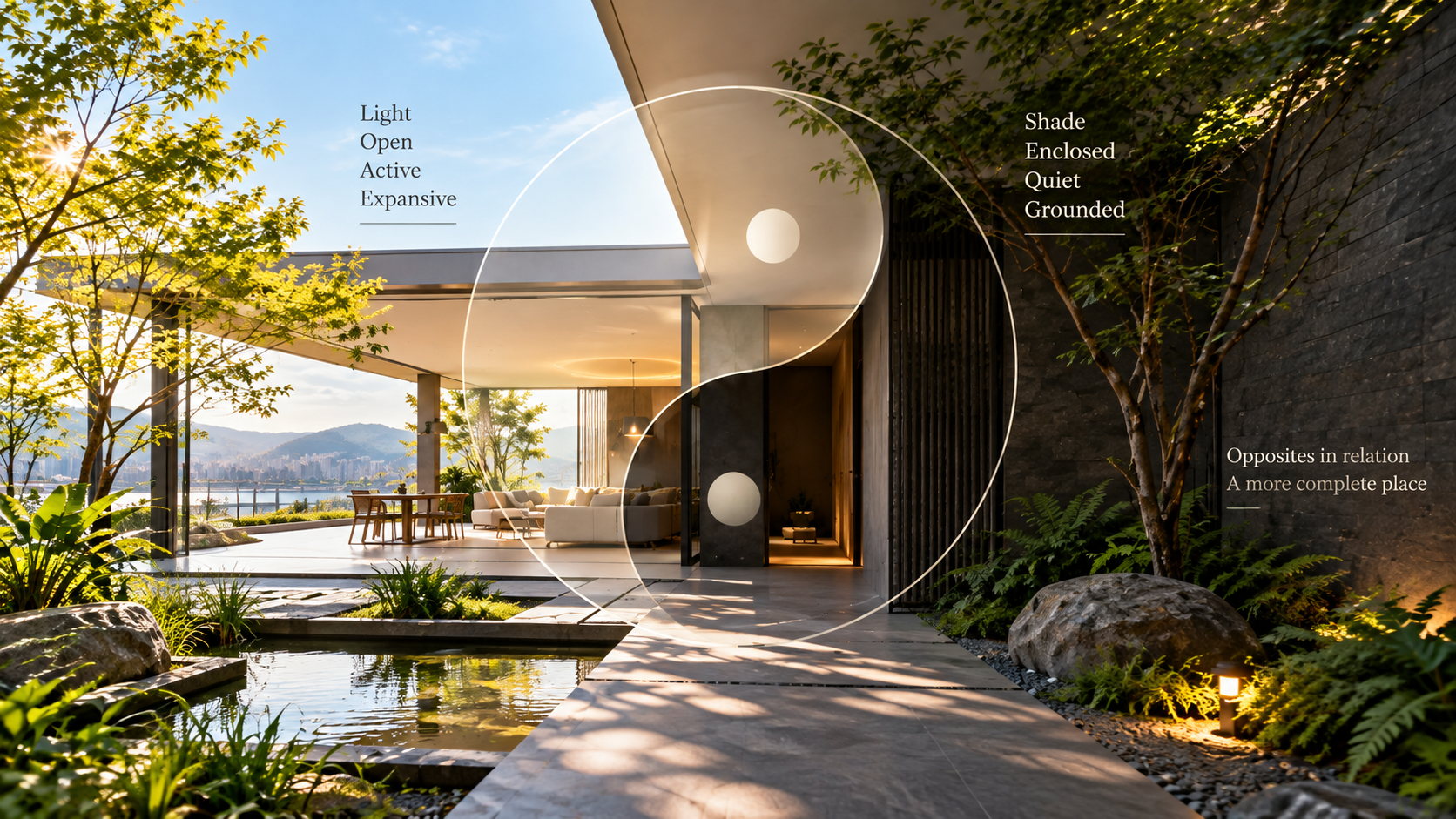
What Is Yin–Yang in Traditional Feng Shui?
What Yin and Yang Mean in Traditional Feng Shui
Yin and Yang are among the most familiar ideas in Chinese thought, yet they are also easily misunderstood. They are often described as two kinds of energy, as though they were separate forces acting against one another. This can be misleading. Yin and Yang are better understood as relative qualities expressed within a single whole.
In traditional Chinese thought, Yin and Yang arise within Taiji, a unified whole rather than two separate forces.
Traditional Feng Shui uses this framework in a practical way. It observes how Yin and Yang appear in the actual conditions of a place and considers whether those conditions support the way the place is meant to be used.
Yin and Yang Are Relative
Yin and Yang are not fixed labels attached permanently to things. A quality is understood as more Yin or more Yang only in relation to another condition. Brightness appears more Yang in relation to shade, while movement appears more Yang in relation to stillness. The same quality may therefore be understood differently when the surrounding conditions change.
This does not mean that Yin and Yang are opposing forces in conflict. They distinguish contrasting qualities, but each is understood through its relationship with the other. Light is more Yang in relation to shade, movement in relation to stillness, and openness in relation to enclosure.
For this reason, nothing is entirely or permanently Yin or Yang in every respect. Traditional Feng Shui compares the qualities actually present in a place rather than assigning it a single fixed label.
Reading Yin and Yang in the Natural Environment
Traditional Feng Shui begins with the observation of the natural environment. Mountains and water provide one of its clearest examples of Yin–Yang distinction. A mountain is generally more Yin in relation to moving water because it appears more stable and settled, while water is generally more Yang because of its movement and activity.
This does not mean that every mountain is simply Yin or every body of water is simply Yang. Mountain forms may appear quiet and contained, or they may rise, extend, and move strongly across the landscape. Water may flow rapidly, move gently, spread across an open surface, or remain enclosed within its surroundings. Their Yin–Yang character depends on how these conditions are actually expressed.
Other differences become visible across the same landscape. Sunlight may reach one part of a site while another remains shaded. Some areas are exposed to movement and activity, while others are sheltered by surrounding landforms and appear more settled. Feng Shui reads these relationships rather than treating particular objects as permanently Yin or Yang.
These differences are part of the broader conditions through which Qi is expressed in a place. Yin–Yang helps distinguish whether those conditions are more moving or still, open or enclosed, bright or shaded.
Buildings remain part of these environmental relationships. They receive light, wind, sound, movement, and protection from their surroundings, while their own form and openings shape how these conditions continue into the spaces within.
How Yin–Yang Conditions Support the Function of a Space
Within a building, different spaces receive and organize light, sound, movement, and enclosure in different ways. Traditional Feng Shui considers whether these qualities support what each space is intended to do.
A bedroom, for example, is primarily a place for sleep and recovery. It therefore benefits from a more Yin character: softer light, less activity, greater quiet, and a sense of stability and enclosure. These conditions help the room settle and support rest. Excessive brightness, exposure, noise, or movement may give the room a more Yang character than its function requires.
Yet a bedroom should not be made as Yin as possible. If it becomes excessively dark, closed, airless, or inactive, it may no longer provide healthy and usable conditions. A work area or a room used for social activity may need more daylight, movement, and connection, but continuous noise, exposure, or stimulation can also make it difficult to concentrate or settle. Yin and Yang are not good or bad in themselves. Their value depends on whether the conditions support the function of the space.
Feng Shui adjustment works by changing these observable conditions rather than by adding a mysterious Yin or Yang energy. A bedroom that is too bright or exposed may need greater softness, quiet, or enclosure. A room that is too dark and inactive may need more light, air, or movement. The aim is not to create equal amounts of Yin and Yang, but to adjust the conditions so that the space better supports its function.
The Yin–Yang condition of a room may also change over time. It may be brighter and more active during the day, then quieter and more enclosed at night. Changes in light, occupancy, activity, and use alter its condition even when the physical room remains the same.
From Yin–Yang to the Five Phases
Yin–Yang gives Traditional Feng Shui a basic way to distinguish the relative qualities present in a place. The Five Phases develop this understanding further by providing a more differentiated framework for describing patterns of activity, relationship, and change.
What Is Qi in Traditional Feng Shui?
Why “Energy” Is Only a Starting Point
Qi is often translated into English as “energy.” The word is useful because it suggests activity, influence, and change. It also helps explain why Qi appears in fields such as Traditional Chinese Medicine and Taiji, where it is understood in relation to life, bodily function, and movement. But “energy” is only a bridge. In modern English, the word often suggests something measurable, transferable, or stored like a physical substance. Qi has a broader meaning within traditional Chinese thought, and Feng Shui approaches it through a particular field of observation: the conditions of a place. Its meaning becomes clearer when we look at how land, water, buildings, boundaries, and spatial relationships create movement, protection, openness, continuity, and change.
Qi Is Understood Through a Place
Feng Shui does not understand a place as a collection of isolated objects. A mountain, a river, an open field, a road, or a building acquires meaning through its relationship with everything around it. The direction of the land, the way water approaches and leaves, the degree of exposure or protection, and the boundaries that hold a place together all contribute to its particular condition. Qi is understood through these relationships. It is not identical to the visible forms of the environment, yet it is not considered apart from them. Feng Shui begins with the place itself and asks how its conditions connect: whether movement continues or is interrupted, whether a site is open or contained, and whether what reaches it can remain or is quickly dispersed. This is why the same physical feature cannot be given a fixed Feng Shui meaning in isolation. Water may strengthen one place and weaken another, depending on its direction, speed, form, and relationship to the surrounding land. An open view may bring space and clarity, while excessive exposure may leave a site without protection. Through Qi, Feng Shui interprets this active dimension of place—how conditions influence one another and what they make possible.
How Qi Moves Through a Landscape
The movement of Qi becomes clearest in a landscape. A mountain range does not stand as a series of unrelated peaks. It rises, descends, turns, divides, and continues across the land. Rivers also have a course: they approach from somewhere, respond to the terrain, curve or rush forward, join other waters, and eventually leave. Feng Shui reads these movements as parts of a larger environmental pattern. Where the land develops through a clear connection from one formation to the next, Qi is understood to move with that larger progression. Where the terrain is abruptly severed, broken, or left without support, that continuity may weaken. The concern is not only the appearance of an individual mountain or river, but whether the landscape carries movement forward as a connected whole. Water makes this dynamic especially visible. A river that bends through the land creates a different relationship from one that cuts directly past a site or rushes away without turning. Its speed, direction, width, and connection with the surrounding terrain all affect how the place is understood. Water does not stand for Qi, nor does Qi move exactly like water. The course of water instead helps reveal direction, convergence, separation, and departure within the landscape. The degree of openness also matters. A site exposed to strong wind and lacking surrounding support may have difficulty retaining what reaches it. A place with appropriate protection can receive movement without immediately losing its form. Yet protection is not complete enclosure. A landscape still needs connection, openness, and room for renewal. This is the more precise meaning behind the familiar expression “Qi flow.” In Feng Shui, it refers less to an invisible current than to the way terrain, water, exposure, and surrounding forms create continuity, direction, convergence, and change.
How Qi Comes to Rest, Gathers, or Disperses
Movement alone does not create a favorable place. If the conditions of a landscape carry everything onward without pause, Qi may continue past a site rather than become established there. Feng Shui therefore considers not only where movement comes from, but whether it can slow, turn, and find an appropriate place to settle. A classical Feng Shui principle describes Qi as dispersing when overly exposed to wind and coming to rest where water helps define the landscape. It directs attention to the relationship among exposure, terrain, and water: whether a place can receive movement, retain it, or allow it to pass away. Water is especially important in this transition. Where it meets the land, curves around it, or marks a change in direction, the larger movement of the landscape may also begin to gather. Yet water alone is never enough. A fast, direct current that rushes away may draw conditions outward, while water that relates more gently to the surrounding land may help create convergence and containment. The land around a site must also participate. Surrounding forms can protect what arrives, define an open centre, and reduce excessive exposure. If everything is tightly enclosed, however, the place may lose connection and renewal. If it is too open, nothing holds together. Gathering depends on a proportionate relationship between movement and rest, openness and protection. Qi gathering is therefore not the absence of movement. It is a condition in which what reaches a place can settle, remain connected, and continue to support life rather than immediately dispersing.
From Landscape to the Home
A house does not stand apart from the landscape principles through which Feng Shui first understood Qi. Even in a city, the ground beneath a building, the roads and structures around it, the direction of approach, and the degree of exposure or protection form the larger setting of the home. The building adds another layer through its orientation, entrances, walls, openings, and internal arrangement. A building does more than enclose space. It reorganizes movement and connection. Its entrance determines how the home meets its surroundings. Walls and neighbouring structures create protection, obstruction, or pressure. Doors, windows, passages, and rooms connect the exterior with the interior and one part of the home with another. Gathering Qi in a home depends on how these conditions work together across different scales. The surrounding environment, the building, and the internal arrangement form one continuous relationship. A home is not understood only from what happens inside its rooms, nor only from the quality of its external setting. Its Feng Shui emerges from how these layers support or disrupt one another. For this reason, gathering Qi is not the accumulation of an invisible quantity inside a room. It is the result of appropriate Feng Shui conditions coming together—from the natural and urban surroundings to the building and the organization of the living space. When these layers work together, movement can enter without immediately rushing away, important spaces can remain connected without being constantly disturbed, and the home can support both activity and rest. Such gathering is not created by sealing a home or preventing movement. A space with no openness, exchange, or renewal may be enclosed without being alive. Nor does constant movement necessarily produce vitality. A home in which every route is exposed, hurried, or pulled outward may fail to settle even when it is bright and well ventilated. The difference between gathering and stagnation lies less in whether movement exists than in what the whole arrangement is capable of supporting. Gathering allows the conditions of a place to become connected and life-supporting. Stagnation appears when those conditions fail to sustain vitality, use, and renewal—whether the space is closed and lifeless or active without ever becoming settled.
What Kind of Qi Is Being Gathered?
Yet coherence alone does not tell us what quality of Qi has gathered. A place may be enclosed, protected, or strongly centred and still feel depleted, harsh, or unable to support continued growth. Qi names the broader activity and condition expressed through a place. To speak of gathering is to ask whether those conditions can settle and remain rather than disperse. Sheng Qi adds another question: does what gathers possess a generative, nourishing, and life-supporting quality? Vitality is closely associated with Qi, but it does not define the concept as a whole. Qi may be forceful without being nourishing, or settled without being alive. Feng Shui does not seek simply stronger Qi or a greater quantity of it. It seeks conditions in which Sheng Qi can gather and continue to support life, development, and renewal. People may respond to these differences before they can explain them. A place may seem lively, stable, oppressive, unsettled, or depleted. Such responses can offer a clue, but they do not by themselves define the Qi of the place. Feng Shui returns to the environment—its land, water, buildings, boundaries, and spatial relationships—to understand what may be producing that experience. The question is not only whether Qi gathers, but what quality of Qi the place is able to receive, hold, and sustain.
Qi Within the Larger Feng Shui Framework
Qi is foundational to Traditional Feng Shui, but it does not explain every quality of a place by itself. Yin–Yang helps Feng Shui understand relative conditions and change, while the Five Phases describe recurring patterns of activity, relationship, and transformation. Neither should be reduced to separate kinds of Qi. Together, these frameworks allow Feng Shui to move beyond the idea that a place simply has more or less energy. The concern is how its conditions relate, what kind of movement and vitality they produce, and whether they can support life in a coherent and continuing way. To understand Qi in Feng Shui is to begin reading a place as an active field of relationships. Land, water, buildings, boundaries, openings, and spatial arrangements do not operate separately. Together they shape how movement continues, where it settles, what can gather, and what kind of life the place is able to sustain.