What Traditional Feng Shui Studies in Order to Understand a Place
A Place Is More Than a Collection of Objects
When Traditional Feng Shui examines a place, it does not assign fixed meanings to isolated features. A mountain, a road, an entrance, or a room cannot be understood in the same way wherever it appears. Its significance depends on where it is, what it faces, how close it is, and how it relates to everything around it.
A road near a house, for example, is not automatically favorable or unfavorable. Its direction, distance, width, level of movement, and relationship to the entrance all matter. Open space, vegetation, walls, or other buildings between the road and the house may also change how strongly it affects the site.
Traditional Feng Shui therefore looks not only at what is present, but at the pattern formed by different conditions. This is why the study of a place begins with its wider environment before moving inward toward the site, the building, and the organization of its internal space.
The Place, the Site, and Its Surroundings
Before a place can be assessed, it must first be clear what the subject of the assessment is. The place being studied may be a parcel of land, a house, an apartment, a building, a settlement, or a particular area within a larger property. Each subject requires a different scale of observation.
A house cannot be understood only through its rooms or exterior walls. Its position within the site, the space around it, nearby roads, neighboring buildings, changes in ground level, and the broader character of the area may all shape its Feng Shui conditions. The same house could be understood differently if it stood on another site or within a different environment.
The field of observation does not always end at the property line. Conditions immediately beside a site often have the most direct relationship to it, but larger or more distant features may still matter when they are prominent, exposed, or clearly aligned with the place.
Traditional Feng Shui moves between these different scales. It identifies the immediate subject, considers the site that contains it, and then looks outward to the surroundings that give it context.
Natural Landforms and Water
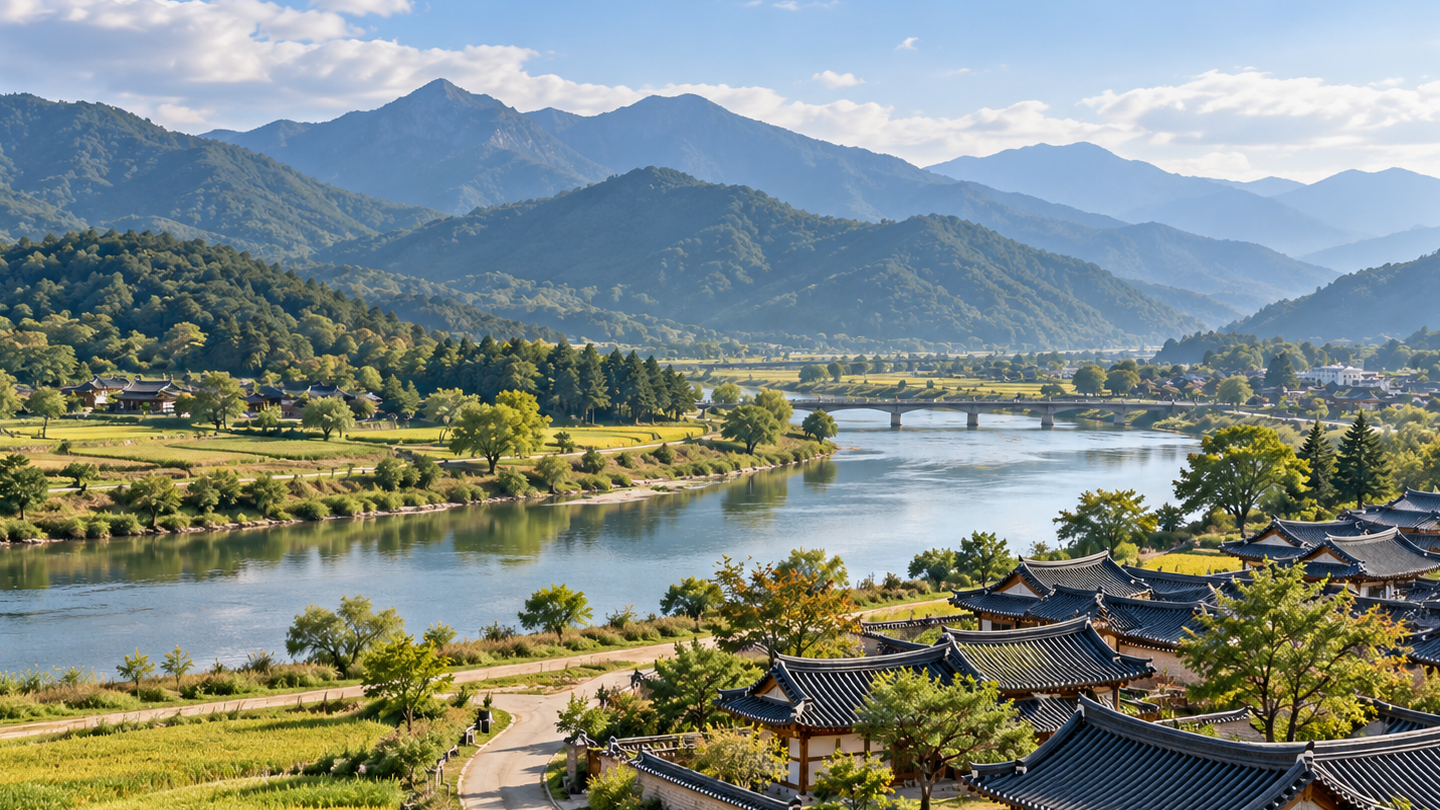
Traditional Feng Shui first developed through the observation of land and water. Before buildings and rooms are considered, the wider terrain establishes the physical setting in which a place exists. Mountains, slopes, valleys, plains, rivers, streams, and open ground all contribute to the larger conditions surrounding a site.
These features are studied not only for their appearance, but also for the movements and relationships they express. A mountain range may approach, continue, turn, rise, or descend. Land may open outward, narrow, enclose, or provide protection. Water may flow toward a place, curve around it, pass quickly, divide, collect, or move away.
The meaning of these forms depends on their relationship to the site. A high landform may offer protection in one position but create pressure or obstruction in another. Open ground may provide space and outlook, yet too much exposure may leave a site without sufficient support. Water may encourage movement and gathering under suitable conditions, while its speed, direction, scale, and distance may produce a different effect elsewhere.
This attention to land and water provides the foundation for later concepts such as the movement, gathering, dispersal, and vitality of Qi. At this stage, the essential point is simpler: Traditional Feng Shui begins by reading the larger patterns of the natural environment.
Orientation and Directional Relationships
Once the wider setting is understood, the next question is how the site or building is oriented within it. Orientation is not only a compass direction. It describes how a place is positioned in relation to what surrounds it.
A building has a front and a back, areas of greater openness and protection, and particular directions from which roads, wind, light, views, people, or other conditions approach. Entrances and major openings connect some parts of the surroundings to the building more directly than others.
The same external feature may therefore take on a different significance depending on whether it lies in front of the building, behind it, beside it, or along the direction of approach. An open view in front of a house creates a different relationship from the same degree of openness behind it. A nearby road, body of water, large building, or elevated landform must also be understood according to its direction and position relative to the site.
Compass measurements and directional systems later make these relationships more precise, but they do not replace the physical setting. At the most basic level, orientation matters because it connects a site or building to actual features in its environment.
Buildings between Site and Interior
Orientation establishes how a building faces its surroundings. The building’s own placement, form, scale, and openings determine how that relationship is physically expressed.
A building does not stand apart from the land around it. Its position on the site may affect how much protection, openness, movement, or exposure it receives from nearby landforms, roads, water, and other structures. Entrances, windows, courtyards, and major openings create more specific connections between exterior and interior.
The form of the building also matters. Height, width, mass, projections, recesses, and the arrangement of different parts influence how the building occupies the site and how its spaces are enclosed or exposed. Two buildings with the same facing direction may therefore have different Feng Shui conditions because their forms, openings, and positions are not the same.
A building stands between the larger environment and the spaces in which people live or work. It receives conditions from outside and reshapes them through its physical structure.
Internal Spatial Organization
Within a building, Traditional Feng Shui examines how space is divided, connected, and used. Rooms and functional areas matter, but their Feng Shui conditions do not arise from their names alone. What matters is how each area is formed and how it relates to the rest of the building.
Walls and boundaries create enclosure and separation. Doors, windows, and other openings connect one area to another or link the interior to the outside. Corridors, stairs, and passages shape movement through the building, while the size and position of openings influence which areas are more exposed, protected, open, or contained.
Changing the stated use of a room does not automatically change its Feng Shui conditions. A room does not become different simply because it is renamed as a bedroom, study, or office. A physical alteration—such as moving a wall, adding or closing an opening, redirecting circulation, or changing the connection between two areas—may have a more direct effect because it changes the organization of the space itself.
The interior still belongs to the larger structure of the building. The location of entrances, the direction of major openings, and the relationship between internal areas remain connected to the building’s orientation, site, and external setting.
A Place Also Exists through Time
Spatial organization describes a place at a particular moment, but Traditional Feng Shui does not assume that those conditions remain unchanged.
Land, surroundings, buildings, and patterns of use may remain stable for long periods, yet they can also change. A new road or neighboring building may alter access, movement, exposure, or protection. A river may shift course, vegetation may grow or disappear, and a building may be extended, renovated, or opened in a different way.
Even when the address remains the same, the relationships that define the place may no longer be identical.
Time also matters because some conditions are temporary while others become part of the established environment. Construction work may create a short-term disturbance, whereas a large building that permanently blocks an opening changes the setting more continuously. How long a condition lasts, whether it repeats, and whether it becomes stable all influence its significance.
Traditional Feng Shui also developed systems for studying how the meaning and influence of a place may vary across different periods. Those methods belong to later study. The basic principle is that a place is understood not only through its arrangement in space, but also through the way its conditions continue and change over time.
Who Uses the Place, and How Are They Affected?
To understand the significance of these conditions, Traditional Feng Shui also considers who uses the place and how it is used.
A house, workplace, shop, school, or temporary lodging may contain similar physical features, but the activities carried out there and the length of time people remain within them are different. A passage crossed only briefly does not have the same importance as a bedroom, desk, or work area occupied for many hours each day.
Some people may use one part of a building regularly, while others rarely enter it. Feng Shui therefore considers where people sleep, work, rest, gather, or move through the space, as well as how frequently and for how long they are exposed to its conditions.
A place may affect people through the ways it supports, restricts, exposes, separates, or connects their activities. A sleeping area, for example, may be influenced by its degree of enclosure, nearby movement, openings, and relationship to adjoining spaces. These conditions are considered together with the wider setting of the building rather than treated as isolated room features.
People may also notice a place through feelings such as comfort, pressure, restlessness, or ease. These responses can draw attention to conditions worth examining, but they do not establish a Feng Shui judgment by themselves. Assessment still returns to the physical and spatial conditions of the place, the people who use it, and the length and frequency of their exposure.
Bringing the Conditions Together
These different observations become meaningful only when their relationships are considered together.
A condition must first be understood in relation to a particular subject. A road may be close to a property but far from the building itself. A large opening may connect one room directly to an exposed exterior condition, while another part of the same building remains protected. A feature may appear prominent when viewed alone but have less influence once distance, proportion, intervening space, or other forms of buffering are considered.
Strength and duration also matter. A large structure directly facing a site may have a different significance from a smaller one farther away. A temporary obstruction does not carry the same weight as a permanent change. A condition affecting a frequently used room may be more relevant to daily life than one affecting a rarely occupied area.
Traditional Feng Shui therefore asks several questions at once: What is the subject? How do surrounding conditions correspond to it? How near or strong are they? How long do they persist? What lies between them? And how do they contribute to the overall pattern?
The final judgment comes from these combined relationships rather than from any single feature.
From the Larger Environment Inward
Traditional Feng Shui understands a place by moving from the larger environment inward. It begins with the wider setting, then considers the site, landforms and water, orientation, the building, and the organization of its internal spaces. Time and human use are added to this spatial picture so that the place is not treated as static or separate from daily life.
This order provides a structure for observation, but it is not a rigid sequence. A building’s orientation must be understood in relation to its surroundings. Internal spaces depend partly on the form and openings of the building. Changes outside may alter conditions within, while patterns of use may determine which conditions deserve the greatest attention.
The purpose of this article is not to teach a complete Feng Shui judgment. It is to show the range of conditions that Traditional Feng Shui studies before reaching one.
A place is understood through the pattern formed by its environment, orientation, physical structure, changes through time, and the lives carried on within it. Later articles can examine each of these areas more deeply, but they remain parts of the same whole.

The History of Feng Shui
1. A Poem About Choosing a Place
In an ancient poem preserved in the Classic of Poetry, Gong Liu leads his people in search of a place where they can settle. The poem belongs to one of China’s oldest surviving collections of verse, whose works largely date from the eleventh to the fifth centuries BCE. Gong Liu himself appears as a traditional ancestor of the Zhou ruling house.
The poem follows him across the land. He climbs to higher ground, returns to the plains, and considers whether the territory can support cultivation and a settled community. He does not treat the place as an empty piece of ground. Its slopes, open areas, water, and exposure to sunlight all matter.
At one point, the poem says that he assessed the land’s “Yin and Yang” and observed its flowing springs. Here, Yin and Yang refer first to the shaded and sun-facing aspects of the land: which parts received more sunlight, which remained cooler, and how the terrain faced its surroundings. The springs also mattered as practical conditions of settlement, providing water for cultivation and everyday life.
This scene preserves an early picture of people reading the conditions of land before deciding where and how a community would live. The poem does not present a developed system under the name Feng Shui. Instead, it shows the kinds of questions from which that tradition would gradually grow: What was the land like? Where did water flow? Which areas received sun or remained in shade? Could the place sustain people over time?
Such questions later appeared in relation not only to settlements, but also to capitals, dwellings, and burial places. They were expressed through different practices and names long before Feng Shui became the familiar term for the larger tradition.
2. Before It Was Called Feng Shui
In an early account of the founding of Luoyi, the future site of the capital was first examined and then submitted to divination. Only after the result was accepted did planning and construction begin.
Early texts described the examination of land or a settlement site as xiangdi or xiangzhai. Divination used to confirm the choice was called buzhai. Practical assessment and ritual confirmation could therefore belong to the same process without being the same act.
Another early technical term was Kanyu, associated with relationships between Heaven and Earth, timing, and systems of divinatory calculation. Its early meanings were not identical to everything later understood as Feng Shui, but over time Kanyu became another name for the wider tradition.
These were not successive names for a single, already complete system. Each addressed a different part of choosing and interpreting a place—examining the land, confirming a decision, considering time, or relating human action to wider patterns of Heaven and Earth. Together, they reveal several of the practices from which the later Feng Shui tradition developed.
These practices were applied in different settings and for different purposes. Among the most important was the selection of places not only for the living, but also for the dead.
3. Places for the Living and the Dead
A place could be chosen for a settlement, a dwelling, or a grave. Each served a different purpose, but none was understood apart from the land around it. Terrain, water, orientation, and the position of a place within its surroundings could all matter.
For settlements and places where people lived, such judgments concerned whether the land could support shelter, cultivation, and daily life. Burial sites belonged to a different domain, yet they too were assessed through their relationship to the wider landscape. The two were not identical, but both formed part of the longer history of selecting and interpreting places.
This does not mean that Feng Shui began only as a burial practice. Concerns with settlements and dwellings were already present in early texts and continued alongside burial traditions. Burial nevertheless became especially important in the development of Feng Shui theory because later writings used burial-site selection to explain broader relationships between land and Qi.
This theoretical importance becomes especially clear in the Zangshu (the Book of Burial).
4. Guo Pu and the Zangshu
Traditionally attributed to Guo Pu (276–324 CE), the Zangshu begins with a concise proposition: burial depends upon receiving Sheng Qi. The surviving text became one of the most influential works in Feng Shui history, although its authorship and formation remain uncertain.
Its central idea is that Sheng Qi moves within the earth. Qi is therefore not presented as an atmosphere detached from physical place. It was understood through the configuration and larger movement of the land.
The text explains: “Qi is carried by wind and disperses; when bounded by water, it comes to rest.” The point is not that wind is always harmful or that the mere presence of water is favorable. What mattered was whether the conditions of the place allowed Qi to disperse or to come to rest.
The Zangshu continues by saying that the ancients sought to gather Qi so that it would not disperse and to guide its movement toward a place of rest. It is in this context that the text explains the name Feng Shui. The name therefore refers not simply to wind and water as objects, but to their relationship with how Qi moves, disperses, and comes to rest.
This became the most influential early textual explanation of the name Feng Shui. It does not establish that Guo Pu invented the term or that the whole tradition began with him; earlier texts had already described the assessment of settlements, dwellings, and other sites. Even so, later Feng Shui traditions came to regard him as a foundational figure because the text attributed to him gave lasting theoretical form to the relationship among burial, land, Qi, wind, and water.
Because Qi was understood to move through the earth, the visible configuration of the land became central to reading a place. This led Feng Shui practice toward the close observation of mountains, valleys, and watercourses.
5. Reading Mountains and Water
To read a landscape was to follow relationships across different scales. A mountain was considered not only by the shape seen from one position, but by its continuity, direction, and relationship to the surrounding land. Water was read in much the same way: where it came from, how it moved through the terrain, and where it turned, widened, narrowed, or continued beyond the place being considered.
This required attention to both the larger movement of the terrain and the local form found at a particular place. A ridge might extend across a broad region before approaching a valley or settlement, while a bend in a river gained meaning through its position within the wider landscape. The immediate form of a place was therefore read as part of a larger continuity.
In later Feng Shui history, this close reading of mountains and water became especially associated with Yang Yunsong, traditionally placed in the ninth century CE. Later tradition places him at the Tang court and tells that, during the upheavals of the late Tang period, he travelled south to Jiangxi. There he became associated with the study of local mountains and water, the teaching of disciples, and the use of Feng Shui within ordinary communities. Later generations called him “Yang the Rescuer of the Poor,” preserving the memory of specialized knowledge passing from the court into local life.
Yet visible landscape was only one part of Feng Shui assessment. A place also had orientation, and some methods interpreted its significance in relation to time. Direction, timing, and systems of calculation would become another major part of how places were understood.
6. Direction, Time, and the Compass
Orientation was more than a direction marked on a map. It described how a place faced and related to sunlight, wind, roads, water, and the surrounding land. Two buildings could stand within the same general landscape yet form different relationships with it because they faced different directions or occupied different positions.
Some Feng Shui methods also considered orientation in relation to time. The interpretation of a place was not always treated as permanently fixed, and the meaning assigned to a direction could vary within different temporal cycles. Approaches concerned with orientation, time, and related systems of interpretation came to be known as Li Qi. Depending on the method, they could draw on Yin–Yang, the Five Phases, trigrams, and cyclical systems of time.
Many Li Qi methods used the Feng Shui compass, or luopan. It served not only to establish direction, but also to organize layers of technical information around a measured orientation. The instrument was central to many Li Qi methods, but Li Qi itself referred to the wider work of interpreting orientation and time.
In modern English-language writing, different emphases within Feng Shui are often grouped under the labels “Form School” and “Compass School.” These familiar terms are useful, although incomplete. Form approaches included much more than the outward shape of an object: they considered terrain, mountains, watercourses, and spatial relationships. Compass approaches involved more than using an instrument: they interpreted orientation and time through broader systems of correspondence and calculation.
Nor were these two entirely separate ways of practising Feng Shui. Some traditions placed greater emphasis on visible landscape, while others developed more detailed methods of orientation and time. Yet the physical conditions of a place gave directional and temporal interpretation its setting, while orientation and time added another layer to the reading of visible form. A complete assessment required attention to both.
The same attention to form, orientation, and time would also shape the way dwellings were studied.
7. Feng Shui Enters the Dwelling
The assessment of dwellings was not new, but surviving writings from the Ming period into the early Qing—roughly 1368 to 1700—brought the home into sharper focus. Earlier traditions had already considered where people should live, how a dwelling faced its surroundings, and whether its site was suitable. During this later period, however, residential Feng Shui became more extensively documented and more explicitly organized around the dwelling itself.
The traditional term Yangzhai referred to dwellings and places for the living. In Yangzhai writings, the house was still considered in relation to its site, orientation, roads, water, and surrounding forms. Increasing attention was also given to its main entrance, principal living areas, kitchen or stove, and the relationships among its internal spaces. The interior did not replace the exterior; it became another scale at which the conditions of a place were examined.
A compilation commonly known as the Yangzhai Shishu, traditionally associated with Wang Junrong and generally placed in the Ming period, brought together a substantial body of material concerning residential Feng Shui. Another influential work, the Yangzhai Sanyao, traditionally attributed to Zhao Jiufeng and associated with the early Qing period, organized residential assessment around three major concerns: the entrance, the principal dwelling area, and the stove. These writings did not create residential Feng Shui, but they show how the home had become a more specialized and detailed subject of study.
The dwelling had become a more explicit field of assessment, but it remained inseparable from its site, orientation, and surrounding environment.
8. A Tradition Formed Over Time
The breadth of Traditional Feng Shui did not appear all at once. Practices concerned with land, settlement, dwellings, burial, orientation, and time developed in different contexts before becoming parts of a larger tradition.
Some began with direct observation: the shape of the terrain, the course of water, the amount of sunlight, or the suitability of land for settlement. Others involved divination, systems of correspondence, calculation, or the interpretation of time. Texts gave these practices theoretical form, while regional traditions and lineages preserved them through field experience and teaching.
Across this long development, the same questions kept returning: What kind of place was this? How did it relate to its surroundings? How should its conditions be understood for the purpose it was meant to serve? The language and methods used to answer these questions changed over time. New texts, tools, classifications, and applications appeared, while older concerns were reinterpreted and carried forward.
No single person, text, or school contains the whole history of Feng Shui. It is better understood as a layered body of knowledge shaped through observation, divination, textual theory, calculation, landscape practice, and transmission. Traditional Feng Shui was formed over time through repeated efforts to understand the conditions of places and the relationships they created among environment, time, and human life.
What Is Feng Shui?
Traditional Feng Shui is a Chinese system for observing and assessing the conditions of natural environments and places shaped by human activity. It considers landscape, landform, water, the position and orientation of buildings, spatial organization, and changing conditions over time. These factors can influence how Qi gathers, moves, or disperses within a place.
From a Feng Shui perspective, a place is not simply a neutral physical setting. Its surrounding environment, physical form, orientation, spatial organization, and conditions at a particular time form a pattern that can be assessed through Feng Shui. Together, these conditions give the place its particular Feng Shui character.
That character is not permanently fixed. Natural landscapes may change gradually, while inhabited and designed spaces can change more visibly through the passage of time or through alterations to buildings, openings, circulation, and layout. Such changes may alter the Feng Shui conditions of a place.
Traditional Feng Shui therefore does not rely on a single object, decorative choice, personal impression, or universal rule. Each feature must be considered in relation to the wider environment and to the methods through which the place is assessed.
What Does Traditional Feng Shui Study?
Traditional Feng Shui does not begin with furniture, decorative objects, or isolated features inside a room. It begins with the wider setting of a place.
The Natural Landscape
At the broadest level, Feng Shui examines the natural landscape. Practitioners assess the vitality expressed through its form, continuity, and movement: the direction of mountain ranges, the bends and movement of rivers, the form of the land, and the way major features gather, open, converge, or disperse.
These features are not treated merely as physical shapes. Their relationships are interpreted for their Feng Shui significance, including how the conditions of the landscape may allow Qi to gather, move, or disperse.
The Site and Its Surroundings
A site is understood in relation to this wider setting. Its position, surrounding landforms, water, openness, enclosure, and relationship to nearby features all contribute to the conditions of the place. A building is therefore not assessed as an isolated object.
Orientation matters at this level because it describes how a building relates to what lies beyond it. A building may face an open and supportive external setting, or it may face a constricted environment affected by disruptive activity or pollution. Feng Shui considers this relationship between the building and the conditions it faces, rather than treating orientation as an abstract direction alone.
In contemporary settings, roads, neighboring buildings, open spaces, industrial structures, and patterns of urban movement may also be considered through related traditional principles. These features are not simply identical to mountains or rivers. Rather, they may be read by analogy through relationships of form, movement, enclosure, exposure, position, and environmental influence.
Buildings and Spatial Organization
Within the site, Feng Shui considers the physical form of the building, its entrances and openings, and the organization of its internal spaces. Boundaries, passages, circulation, and the relationships among different areas all form part of the conditions being assessed.
At this level, the concern is not simply whether a room looks attractive. Feng Shui examines how the structure and arrangement of the space affect its overall pattern and how Qi may enter, gather, move, or disperse within it.
Time and Physical Change
Time and physical change are also relevant. Natural landscapes generally change gradually, while inhabited and designed spaces may change more quickly through renovation or alterations to entrances, openings, layout, circulation, and other material features.
A change in the stated use of a room does not by itself alter its Feng Shui conditions. Physical changes made to accommodate that use, however, may alter the conditions of the space.
Taken together, these layers allow Feng Shui to assess a place as a connected and changing whole rather than as a collection of separate objects, labels, or universal rules.
Feng Shui Is Not Only a Feeling
The atmosphere of a place and the way people feel within it matter in Feng Shui, especially in a home where people spend a significant part of their daily lives. Personal feeling alone, however, does not determine the Feng Shui of a space.
A person may feel calm, uneasy, focused, distracted, comfortable, or constrained in a particular environment. These responses may be influenced by the physical and spatial conditions of the place, but they may also be shaped by mood, physical condition, memory, preference, and expectation. An individual reaction therefore cannot by itself establish whether the Feng Shui conditions of a place are favorable or unfavorable.
Feng Shui first examines conditions of the place itself, including its surrounding environment, physical form, orientation, spatial organization, openings, circulation, and condition at a particular time. These conditions may contribute to the atmosphere of the place and to the way people experience being there. They do not change simply because a different person enters the space or responds to it differently.
Not every condition assessed in Feng Shui is immediately or consciously felt by the people using the space. Human experience can provide useful information, particularly in an inhabited environment, but it remains one part of a broader assessment rather than the sole basis of judgment.
Feng Shui may overlap with environmental psychology in its concern for how surroundings affect human experience, but it is not simply a psychology of space. Traditional Feng Shui has its own concepts and methods for assessing a place.
Where Qi Fits
Qi is one of the central concepts in Traditional Feng Shui, but it is not exclusive to Feng Shui. It is a foundational idea found throughout Chinese culture and traditional thought, including fields such as Chinese medicine and traditional movement practices such as Tai Chi. Each field understands and applies Qi within its own context.
In the natural landscape, Qi may be understood as present within and expressed through the condition, vitality, and movement of the environment. The continuity of mountain ranges, the movement of water, and the capacity of land to sustain growth can all help convey how vitality is recognized in nature.
The vitality that Feng Shui practitioners look for in mountains, rivers, and landforms is closely related to this understanding of Qi. A landscape with continuity, coherence, and a clear sense of movement may express vitality. Vitality helps convey one aspect of what practitioners recognize when they speak of Qi in a living landscape, but it is not a complete translation of the concept.
In a built or inhabited space, Qi is understood through the relationships among the external environment, the position and form of the building, its orientation, openings, spatial organization, and changing conditions over time. These relationships can influence how Qi gathers, moves, or disperses within the place.
A building does not therefore have favorable Qi simply because it is attractive, expensive, or well decorated. Its Feng Shui depends on the relationships among the building, its surroundings, and the way its spaces are formed and connected.
Qi should not be reduced to a vague form of ‘energy,’ a pleasant atmosphere, or a label for whatever feels comfortable. In Feng Shui, it belongs to a broader system for understanding relationships among form, movement, position, space, and time.
Yin–Yang and the Five Phases
Yin–Yang and the Five Phases—often called the Five Elements in English—are two foundational frameworks in Traditional Feng Shui. They help practitioners understand the qualities, relationships, and changes present within an environment, but they approach these questions in different ways.
Yin–Yang describes relative, complementary, and interdependent conditions. Light and dark, movement and stillness, openness and enclosure, activity and rest may all be understood through Yin–Yang relationships.
Neither Yin nor Yang is inherently favorable or unfavorable. Feng Shui considers the relationship between them and whether that relationship is appropriate for the place and its use.
The Five Phases provide a different framework. Wood, Fire, Earth, Metal, and Water do not refer simply to five physical substances. They represent five modes of movement and activity through which phenomena can be classified and related.
The Five Phases help explain how different qualities and conditions interact, support, regulate, or restrain one another. Through these relationships, they provide a way to understand connections and changes among different phenomena.
In popular Feng Shui, Yin–Yang and the Five Phases are often reduced to decorating advice: adding brighter light, choosing a particular color, or placing an object associated with one of the five categories. Such choices may sometimes be relevant, but they do not by themselves constitute a Feng Shui assessment. Their meaning depends on the broader conditions and relationships of the place.
What Feng Shui Is Not
Feng Shui is often introduced through furniture placement, color, decorative choices, or advice about attracting luck and prosperity. These may appear in Feng Shui practice, but they do not by themselves define Traditional Feng Shui.
Feng Shui is not simply interior decoration. Furniture arrangement, color coordination, and visual harmony can all be relevant to Feng Shui. They may reflect considerations of spatial organization, the Five Phases, Yin–Yang, movement, and the relationships among different parts of a place. These methods have Feng Shui significance only when they are guided by a broader assessment and supported by Feng Shui principles. Without that foundation, they remain matters of design or personal preference rather than Feng Shui practice.
Feng Shui is also not merely a system for creating ‘positive energy.’ Qi is a central concept, but it should not be reduced to a general feeling, mood, or vague form of energy. In Feng Shui, Qi is understood through the actual conditions and relationships of landscapes, buildings, and spaces.
Nor is Feng Shui based solely on personal intuition. Human experience can provide useful information, especially in a home, but feeling comfortable or uncomfortable does not by itself establish the Feng Shui of a place.
Feng Shui is not a universal list of placement rules. No single color, material, object, arrangement, or direction has the same Feng Shui meaning in every environment. Its relevance depends on the conditions of the place and on the principles and methods through which those conditions are interpreted.
Traditional Feng Shui has often been concerned with practical benefit and favorable outcomes, including well-being, livelihood, family life, opportunity, and material circumstances. These aims do not reduce Feng Shui to promises of luck, wealth, or immediate results.
A Brief Historical Orientation
Traditional Feng Shui developed in China over many centuries as a body of knowledge and practice concerned with landscapes, sites, buildings, and the ways people locate, build, and live within an environment.
Its early applications were closely connected with the reading of natural landforms, the movement of water, the selection of sites, and the placement and orientation of structures. Feng Shui was applied both to burial sites and to places for the living, reflecting the importance traditionally given to the relationship between land, family life, and human settlement.
Over time, different methods and traditions developed for assessing landscape form, orientation, spatial relationships, and changing conditions over time. These approaches were not identical, but they shared the understanding that a place should be studied in relation to its wider environment rather than treated as an isolated object.
Contemporary household applications belong to this continuing tradition, but they are best understood within its broader environmental and historical framework.
How Feng Shui Is Used Today
Traditional Feng Shui continues to be used in the selection, positioning, organization, and adjustment of places.
In site selection, Feng Shui examines the wider landscape and surrounding conditions in order to identify a favorable location for a building or settlement.
After a site is selected, Feng Shui also considers how the building is positioned and oriented in relation to the wider environment. Its orientation is not treated as an abstract direction alone, but as part of the building’s relationship with the land, surrounding forms, openings, and the conditions it faces.
Only after these wider relationships are considered does Feng Shui move inward to the organization and use of the spaces within the building.
In existing homes and other inhabited spaces, Feng Shui is often applied through spatial arrangement. This may include the relationships among entrances, openings, rooms, pathways, functional areas, and furniture. Color, light, and visual relationships may also be relevant when they are used within a broader Feng Shui assessment and supported by principles such as Yin–Yang and the Five Phases.
Feng Shui adjustments begin with an understanding of the existing conditions of the place. Changes may involve layout, circulation, openings, the physical organization of particular areas, furniture arrangement, color, or other physical features. An adjustment is not a universal remedy; it must respond to the particular conditions identified through Feng Shui.
In contemporary cities, Feng Shui is often applied within environments that already exist. Roads, neighboring buildings, open spaces, traffic, and other urban features may form part of the wider conditions considered in an assessment.
Whether Feng Shui is used in selecting a site or adjusting an existing home, its application begins with reading the place as a whole rather than applying an isolated rule.
Conclusion
Traditional Feng Shui is a way of reading, understanding, assessing, and working with the conditions of environments and places.
It begins with the wider landscape and surrounding environment, then considers the site, the position and orientation of the building, the organization of space, and changing conditions over time. Within this broader framework, Qi, Yin–Yang, and the Five Phases provide important ways of understanding the qualities and relationships present within a place.
Learning Feng Shui is not about memorizing countless rules. It is about observing environments more carefully, recognizing relationships that might otherwise be overlooked, and developing a more informed way of understanding and working with the places we inhabit.
A fuller understanding begins with the foundational concepts of Qi, Yin–Yang, and the Five Phases. These concepts provide the language needed for later discussions of landscape, orientation, spatial organization, time, and practical application.