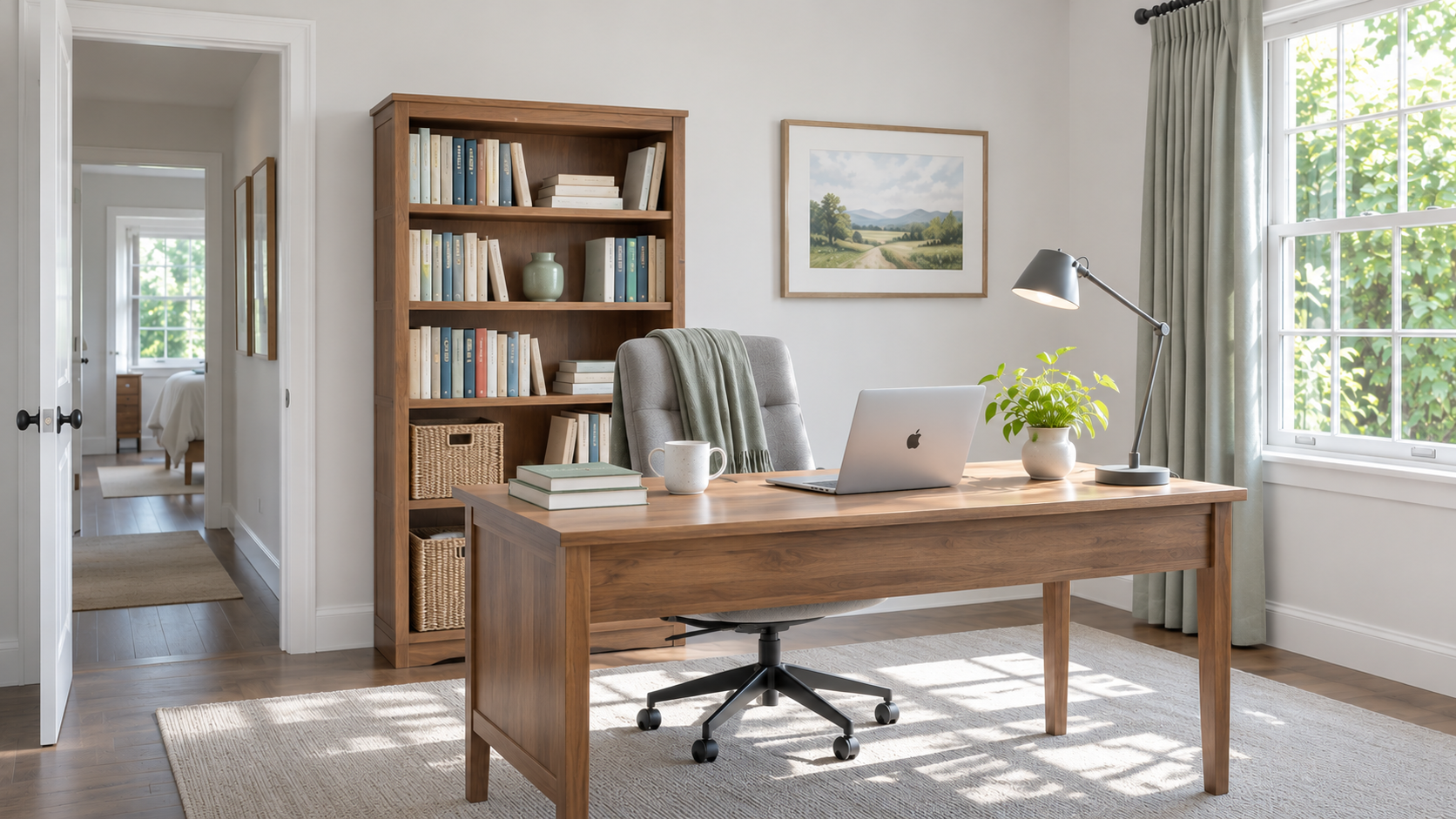
“Which way should my desk face?” is probably the question people ask most about desk Feng Shui. Most English-language sources give much the same answer: sit with a solid wall behind you, where you can see the door without being directly in line with it. This spot even has a name: the command position.
The command position is an interesting idea. Traditional Feng Shui has no matching term, but the thinking behind it, a vantage point from which you can take in the whole scene, is close to the spirit in which Feng Shui reads a landscape. When traditional Feng Shui reads the forms and configurations of a place, it looks at an entire setting of mountains and water, and it does so for a clear purpose: to find where qi (氣) gathers across a wide area. That is work on a large scale. A desk is a small-scale matter. The reasoning carries over, but the method cannot simply be shrunk down from a valley to a desk.
So the principle behind the command position can be applied to a study, but its method can’t be copied directly. English-language advice puts great weight on being able to see the door. I don’t. Where a desk should go depends on the actual conditions of the space: which of them are favorable and which are not. If your layout lets you see the door, that’s good. But you shouldn’t give up other, more important conditions just to see the door.
This article, then, is about the relationship between your desk and your room, rather than about which direction it should face.
The short answer: there is no single best direction for a desk. Start with the places your desk can actually go. For each one, rule out unfavorable conditions first: a beam directly overhead, an exposed back (a door, a walkway, or a large window behind you), and being in direct line with a door. Then look for favorable ones: solid backing behind you, open space in front of you, and steady light. Which of these matters most depends on your room. And whatever your layout, you can always start by clearing your desk.
Start with Where Your Desk Can Go
Instead of asking which way your desk should face, look at your room and list the places where a desk can realistically go. Then check each one: which unfavorable conditions does it avoid, and which favorable conditions does it have? The direction your desk faces comes out of that comparison. It isn’t decided first, with the room forced to fit around it.
Why No Single Rule Always Matters Most
No two rooms are exactly alike. Even two rooms with the same floor plan, one directly above the other, end up arranged differently, because the people using them have different habits and preferences, and this is truer of a study than of most rooms. So in desk Feng Shui, no single rule is always the most important. The way to judge is this: whatever affects your desk the most is what your study most needs you to pay attention to.
This is also why the desk Feng Shui rules you find online so often contradict each other. Some say never face a wall; others say a wall in front is steadier when you work with several monitors. Some say having your back to the door is the worst thing you can do; others say a mirror will fix it. Under certain conditions these rules aren’t wrong, but they don’t apply to every space. The same rule carries different weight in different rooms, and sometimes it shouldn’t be raised at all.
Why Feng Shui Advice Seems to Contradict Itself
Many Feng Shui books seem to contradict each other, but often they are simply written from the standpoint of different traditions. Take the desk. In the Xing Shi lineage (形勢派), often known in English as the Form School, a desk’s position is usually fixed. In Flying Star Feng Shui (飛星風水), which follows how conditions in a home change over time, a practitioner may want to move the desk every few years, or even every year. The two look contradictory, but each rests on its own theory.
Most people have no chance to study each tradition in depth, and Feng Shui information online mostly comes as short lists of rules. The more often something is passed on, the more rules pile up, and the more confusing it all becomes. That isn’t anyone’s fault. It’s what happens when a process that needs judgment of the whole is broken into separate rules: once they are separated, you can no longer see which ones weigh more, or which should come first.
In my view, you can tell how deeply someone understands Feng Shui by one thing: whether they can judge how serious each factor is, and in what order to deal with them. That sense of order is what a real grasp of traditional Feng Shui looks like.
How to Decide: Rule Out the Unfavorable First
Traditional Feng Shui avoids unfavorable conditions before it seeks favorable ones. The order matters. However good a spot is in other ways, if a beam presses down from above, or people walk back and forth behind you, those good conditions can’t do their work.
In practice, you can go step by step:
- List the places in the room where your desk could go.
- Check each one for unfavorable conditions. Is there a beam directly overhead (a structural source of pressure)? Is your back exposed, with people coming and going or movement behind you (a psychological source of pressure)? Is the desk in direct line with a door, or does it put your back to the main entrance (disruption from people passing)?
- Then look for favorable conditions. Is there something solid behind you, such as a wall or a bookcase, what tradition calls backing (靠山)? Is there open space in front of you, room for your eyes and thoughts to open out? Are the light and the outlook steady?
- Decide which factor affects this room the most, and deal with it first. Then check again: has the change created a new problem?
Keep in mind that Feng Shui never looks at one condition alone; it looks at how all the conditions relate. The space the desk sits in is part of the judgment, too. Imagine a ground-floor room on a busy street, with traffic, passers-by, and street vendors calling out right under the window. Even if the room has other good qualities, using it as a study, a room that needs quiet, is a mismatch between the space and its purpose, and no desk arrangement can fully make up for it. In the same way, in a study or an office, a desk facing a bathroom door will be disturbed by people going in and out, no matter which way it faces.
On the surface, these look like psychological issues. But psychological unease is one of the clues Feng Shui works with. When you sit somewhere and can’t settle or focus, that is often a sign that something in the space is wrong. Follow that clue further, and you arrive at the Feng Shui judgment itself.
Five Relationships Around Your Desk
A desk can be read through five relationships around it: what is behind it, what is in front of it, the door, the window, and what is above it.
Behind You: Backing, No Backing, and an Exposed Back
A solid wall or bookcase behind you makes a seat stable. That is backing, and it’s the condition people mention most often in desk Feng Shui.
But having no backing is not the same as having an exposed back, and the two are easily confused. In a larger room, a desk may stand some distance in front of a bookcase or a wall. That desk has no backing, but its back isn’t exposed. Different spaces present different conditions, and if a desk has been placed this way for other good reasons, having no backing isn’t necessarily a problem.
The difference lies in stability. An exposed back is mostly a matter of insecurity and disturbance: behind you is a door, a walkway, or a floor-to-ceiling window, where things come and go and there is movement, so you can’t relax as you sit. That is why, in the order of judgment, an exposed back is worse than no backing.
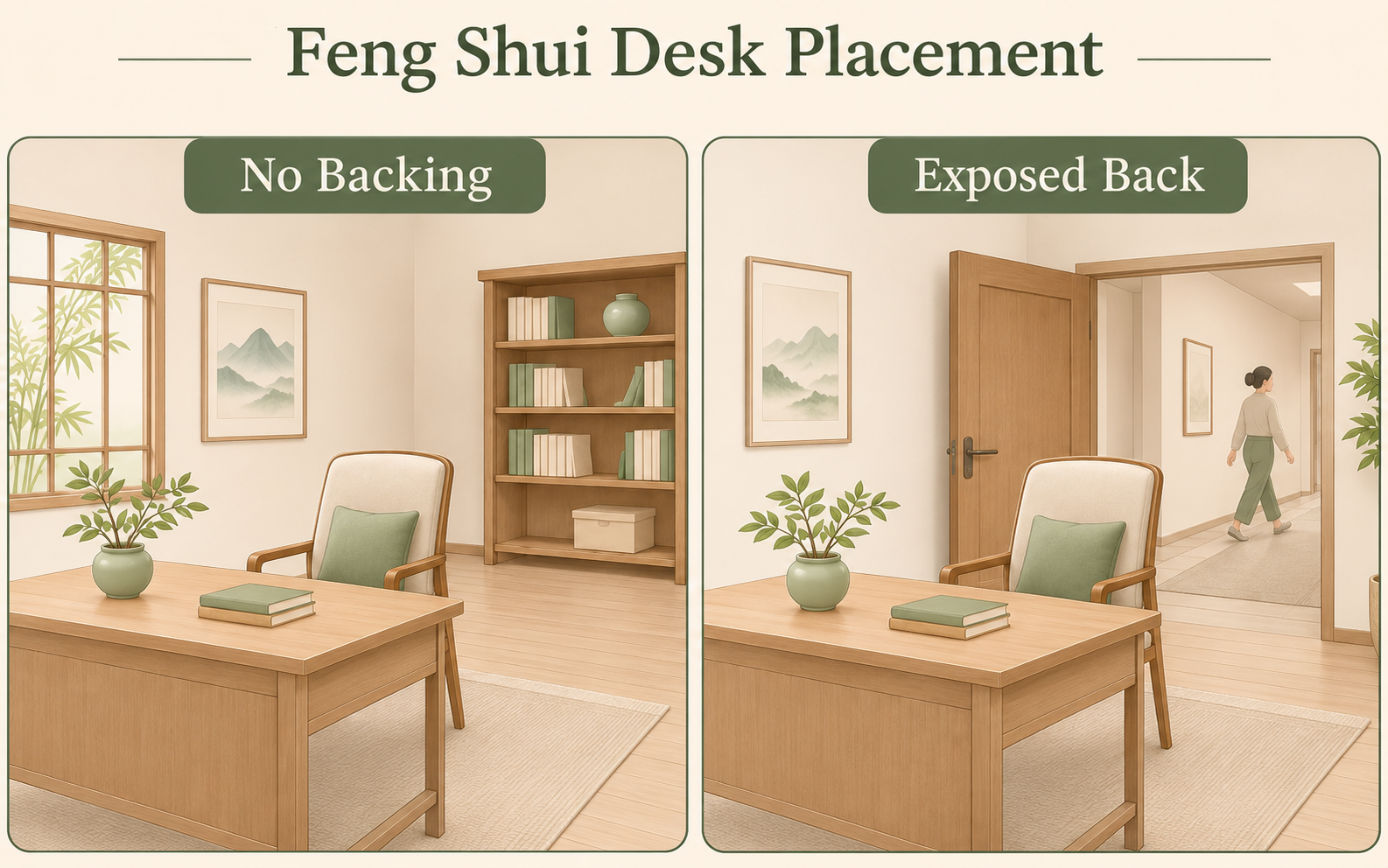
On the large scale of landscape, what Feng Shui watches for most behind a site is ground that falls away: a hollow, a pit, a valley, where the land drops out instead of giving support. Feng Shui takes this very seriously. Brought down to the small scale of a home, the same idea becomes the question of whether or not you have backing.
In Front: Can Your Desk Face a Wall or a Window?
The space in front of a desk can be understood, on a smaller scale, through the traditional Feng Shui idea of Ming Tang (明堂), or “Bright Hall.” It is a place where your eyes and your thoughts can open out. When it comes to what is in front, many people ask: can my desk face a wall?
The Chinese expression mian bi si guo (面壁思過) describes facing a wall to reflect on one’s mistakes. Can a desk face a wall? Of course it can. Here, facing a wall is not a punishment; it may encourage a more inward-looking state of mind and provide a setting for examining your ideas and decisions. It can be a posture of self-reflection and growth. Facing a window is more a posture of thinking about the world outside, and about the future. Either can be the right way for a desk to face.
The Door: Is Your Desk in Line with It?
The relationship between desk and door is one of the most discussed topics online. Traditional Feng Shui has a name for one of the most common problems of form: direct door alignment (men chong, 門沖). Put simply, it means the desk sits in a straight line with a door, whether the door is in front of you, behind you, or to the side, and whether it is a room door or a bathroom door.
A modern reading might call it a disruption of traffic: someone comes in, and your concentration breaks. But Feng Shui reads qi, and a door is a passage through which qi comes and goes. A desk standing in that path is a source of unsettledness.
The Window: A Channel to Nature
In the studies of classical Chinese scholars, the window had a special meaning. It was a channel between a person and nature. It kept out the noise of the world while letting in the breeze, the moonlight, and the colors of mountains and water. In a small room, the window was a conversation with the universe.
In Feng Shui, an east window lets in the fresh, rising qi of the east, associated with Wood among the Five Phases (五行, often translated as the Five Elements). A west window lets in the quiet of dusk. A north window filters out direct sunlight and carries a mood of stillness and reflection.
We are talking about desk Feng Shui, but seen another way, Feng Shui is also a kind of awareness of space.
Above: Beams and Heavy Lights over Your Desk
A beam over the desk is one of the most often cited taboos in study Feng Shui. Beams and columns are what hold a building up; they are its load-bearing points. Traditional Feng Shui recognized long ago that load-bearing points, in a house and even in the natural landscape, affect the conditions around them, and mostly not for the better. Many forms of Sha (煞) associated with physical configurations involve conditions of rushing, striking, pressing, or oppressive proximity.
When a desk or chair sits under a beam, or a heavy pendant light hangs directly over the desk, there is pressure from above. Sitting beneath it, the body feels that pressure before anything else, and it’s hard to relax and concentrate. A low ceiling is judged the same way.
There is a great deal online about beams. It often links a beam directly to all sorts of consequences for your career or your relationships, and offers a range of objects to cure it. My view is this: the sense of pressure is real; that much is certain. But consequences like these aren’t decided by any single condition. The first thing to do is move the desk out from under the beam. If that truly isn’t possible, you can reduce the visual pressure through interior design, for example by finishing the ceiling so the beam is less conspicuous.
Fix One Problem, Create Another
Picture a common situation. A desk sits under a beam, and it feels oppressive, so it’s moved out from under the beam. But now the desk’s back is closer to a floor-to-ceiling window. The beam problem is gone, but the desk now has an exposed back. One problem solved, another created. In Feng Shui, problems are often connected this way: change one thing, and others move with it.
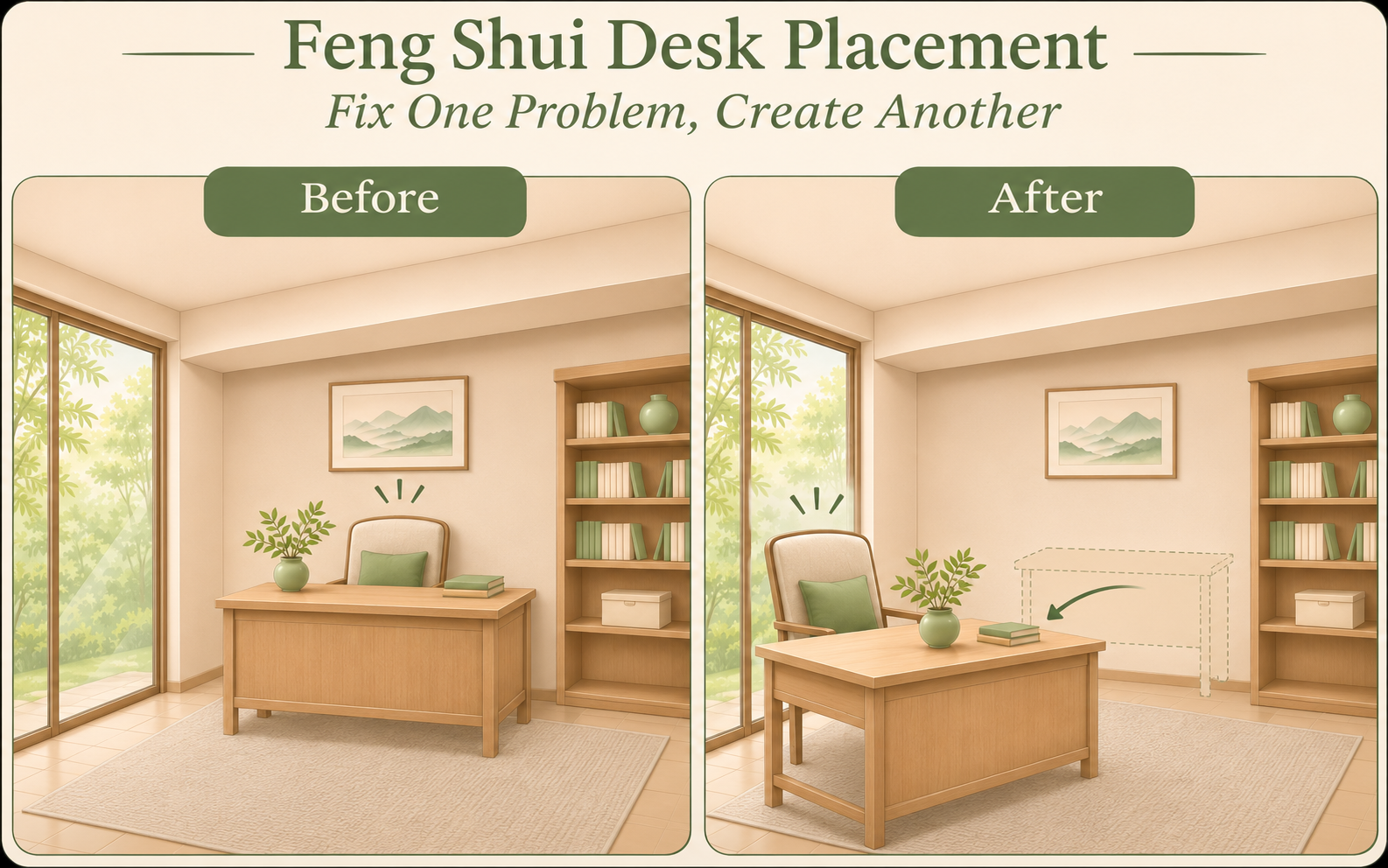
If you only remember the rule “don’t sit under a beam,” the move looks right. Seen from the whole room, the real question is which affects this desk more: the beam or the exposed back. That’s why the question isn’t simply which way the desk faces, but what the whole space around it is like.
Simple Feng Shui problems you can adjust yourself. If the situation is more complicated, it’s best to consult a Feng Shui practitioner, so that a well-meant change doesn’t make things worse.
A Desk in the Bedroom, or No Study at All
The size of a study isn’t the point. A large study may hold more bookcases and books, but that doesn’t make you more learned, or mean you’ll learn more, does it? Whether a large or small study is good depends on its Feng Shui conditions.
Many modern homes have no separate study, and the bedroom often doubles as one. There’s nothing wrong with a desk in the bedroom. What to look for is the same as in a study, and the desk’s position remains the center of judgment: wherever the desk is, that is where you read from.
The difference is that the room now holds two positions that deserve attention, the bed and the desk. So the question isn’t only whether the desk should face the bed. The more basic point is that you shouldn’t neglect the bed’s placement for the sake of the desk, or the other way around. Each position has to work on its own first; then you look at how the two relate.
Your Desk Is Your Own Ming Tang: Clear It First
Almost every discussion of desk Feng Shui talks about what to put on the desk: plants, crystals, a scholar’s brush and inkstone, all kinds of ornaments. My advice is simple: clear the desk first, then add things. While the desk is cluttered, nothing you place on it will help.
Your desk is the Ming Tang of your own personal Feng Shui. Keeping a desktop clear and orderly can help create a more organized setting for thinking and working. If there is no small open space in front of your desk to serve as a Ming Tang, then the desk itself is your Ming Tang.
So if you can change only one thing, whatever your layout, start by clearing your desk. Once it’s clear, a small plant is a nice addition. In the Five Phases, Water generates Wood, and a plant is a sign of life. Think of it as a gesture of care, not as something to improve your grades or your finances.
Frequently Asked Questions
Can I use a mirror if my back is to the door?
This is common advice in English-language sources: if your desk has to face away from the door, put a mirror on the desk or behind you so you can see the doorway.
Chinese studies often had mirrors, but their main purpose was for tidying one’s appearance, because Chinese culture holds that a person’s inner state shows in their outward appearance. A mirror may give you a sense of security when your back is to the door, but that is a psychological effect. In Feng Shui terms, having your back to the door still means what it means.
What if I can’t move my desk at work?
At work, desks often can’t be moved, and that is a genuine difficulty. An office is also planned differently from a personal study at home.
How well a company or a department performs is often tied directly to its manager, so traditional Feng Shui pays particular attention to the manager’s position. In an office, the command position only needs to be considered for the boss or the head of the department. Beyond that, the facing of the manager’s office, the position of its door, and how the two relate all need to be taken into account.
If a manager is willing to follow Feng Shui advice and replan the whole office, including the position and facing of the manager’s desk and where each department sits according to the nature of its work, then the planning concerns the office as a whole, not any one person’s desk.
If you’re an employee and can choose your own seat, the first thing to check isn’t the command position. Look up: is there a beam overhead? And look ahead: is your desk in line with a door or a large column? If you can’t choose your seat, there is still one thing you can always do: clear your desk.
Is there a best direction for a desk? Do different schools of Feng Shui contradict each other?
The desk Feng Shui in this article belongs essentially to the Xing Shi lineage. It looks first at the seat and its surroundings, not at compass directions. As long as the seat’s conditions are right, any facing can work.
There are at least four or five other approaches. Their differences do not necessarily mean that one approach is wrong. Compass directions and Wenchang (文昌), the traditional position associated with study and learning, for example, belong to a different level of judgment, which we’ll come to in another article.
The desk Feng Shui you commonly find in books and online usually covers only taboos. Those taboos aren’t wrong, but they can leave the narrow impression that this is all Feng Shui has to say. In fact, there are many methods for placing a desk, and they usually draw on the theory of the I Ching, which is hard to follow without some groundwork.
Can I use a Bagua map to decide where my desk goes?
A common approach online is to map the meanings of the eight trigrams of the Bagua directly onto areas of your space, treating one area as your career area and another as your knowledge area, say, and then putting your desk there. It isn’t that simple.
Traditional Feng Shui distinguishes two principal Bagua arrangements, each with its own meaning and use. The Bagua maps often found on English-language websites may also follow different methods for assigning areas of life to parts of a room. These are not necessarily the same system. So when you come across a chart that matches Bagua directions to areas of life, don’t rush to move your desk.
Does desk Feng Shui really work?
If you’re asking whether placing your desk this way will get you a PhD, my answer is simply no. Feng Shui never rests on a single condition, and desk placement is a single condition.
Does that mean desk Feng Shui doesn’t matter? Quite the opposite. The desk is one of the easiest parts of Feng Shui to adjust, and the arrangement of studies and desks has long held an important place in traditional Chinese scholarly culture. We have always looked for ways to think more clearly and work more effectively, and Feng Shui is one of them.
Finding the Right Place for Your Desk
Back to the question we started with: which way should your desk face? The answer isn’t a direction. It’s in your room.
Clear your desk first. Then find the factor that affects your room the most, and start there. Desk Feng Shui isn’t a list of rules; it’s learning to see the relationship between a desk and the space around it.
As for why tradition took the study so seriously, and what kind of judgment Wenchang represents, we’ll turn to that in the next article.